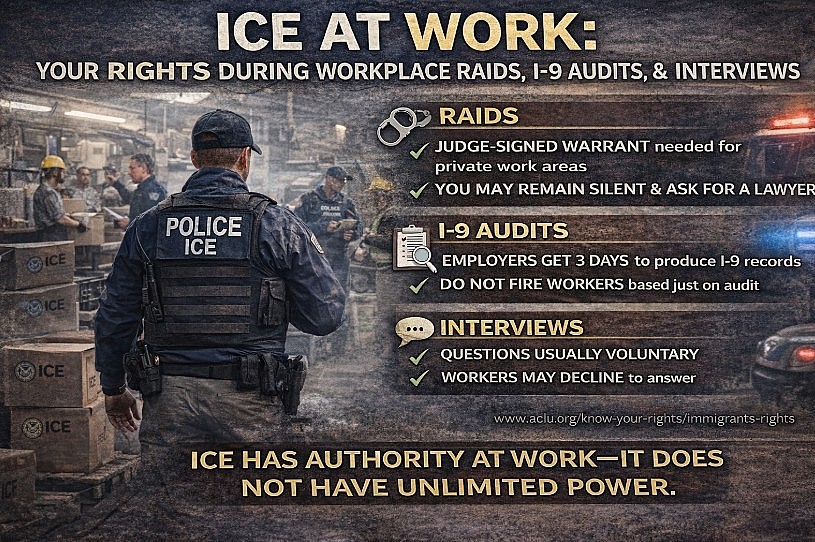
ICE at Work: Your Rights During Workplace Raids, I-9 Audits, and Interviews

 |
| What happens when ICE comes to work? |
Workplace enforcement is one of the most common—and disruptive—ways Immigration and Customs Enforcement (ICE) enforces immigration law. These encounters often happen with little warning and create confusion about who must comply, what documents matter, and what rights workers actually have.
This guide explains the three most common types of ICE workplace actions, the legal rules behind each, and what both employees and employers should know.
The Three Ways ICE Shows Up at Work
ICE does not always arrive with handcuffs. In fact, most workplace encounters fall into one of three categories, each governed by different legal rules.
1. Workplace Raids: The Most Disruptive Scenario
A workplace raid involves ICE agents physically entering a job site to detain specific individuals.
What ICE Needs
-
A judge-signed search warrant to enter non-public areas
-
Or valid consent from the employer
An administrative warrant, signed only by ICE, does not authorize agents to search private work areas.
What Workers Should Know
-
You may remain silent
-
You may ask for a lawyer
-
You generally do not have to answer questions about immigration status
Legal basis: Fourth and Fifth Amendments
ACLU overview: https://www.aclu.org/know-your-rights/immigrants-rights
2. I-9 Audits: Paperwork, Not Arrests
Far more common than raids are I-9 audits, also called Notices of Inspection.
ICE uses these audits to check whether employers properly verified employees’ work authorization using Form I-9, required under federal law.
What Employers Receive
-
A written Notice of Inspection
-
At least three business days to produce records
Statute: Immigration Reform and Control Act (IRCA)
https://www.law.cornell.edu/uscode/text/8/1324a
What Employers Must Do
-
Produce I-9 forms and requested payroll records
-
Avoid over-correcting or re-verifying selectively
What Employers Must Not Do
-
Fire workers immediately
-
Ask only certain workers for extra documents
-
Discriminate based on national origin or appearance
3. ICE Interviews: Voluntary but Intimidating
ICE may attempt to interview workers on-site, sometimes during audits.
Key point: Interviews are usually voluntary.
Workers may:
-
Decline to answer questions
-
Ask to speak with a lawyer
-
Leave the interview if not detained
ICE guidance itself acknowledges that interviews without detention rely on voluntary cooperation.
Read more:
- Is Warning Others About ICE Illegal? Obstruction Laws vs First Amendment Protection
- What is the 100-Mile Border Zone, And How Far ICE and Border Patrol Powers Really Go
- ICE Agents Explained: Who They Are, What They Do, and Why They’re Under Scrutiny
- Border Patrol Agents Explained: Who They Are, What They Do, and How They Differ from ICE Agents
Warrants Matter: Know the Difference
| Document ICE Shows | Signed By | What It Allows |
|---|---|---|
| Search warrant | Judge | Entry/search as specified |
| Arrest warrant | Judge | Arrest of named individual |
| Administrative warrant | ICE | Arrest authority only |
If ICE cannot show a judge-signed warrant, employers may lawfully limit access to public areas.
High-Profile Examples
Mississippi Poultry Plant Raids (2019)
ICE arrested nearly 700 workers across multiple facilities. Later investigations found labor law violations by employers, shifting scrutiny toward workplace practices rather than workers alone.
Ongoing I-9 Enforcement
ICE continues to emphasize audits over raids, with thousands of inspections annually and millions of dollars in civil fines assessed against employers.
ICE statistics: https://www.ice.gov/features/worksite-enforcement
Practical Guidance for Employers
-
Designate a trained point of contact
-
Ask to see warrants and inspect signatures
-
Call legal counsel immediately
-
Document all agent requests
Preparation reduces risk—for both compliance errors and civil liability.
Practical Guidance for Workers
-
Stay calm
-
Do not run or resist
-
Do not present false documents
-
Clearly state if you choose to remain silent
Rights do not depend on immigration status.
FAQs
Can ICE take employee records without a warrant?
Only records specified in an audit notice or warrant.
Can my employer force me to answer ICE questions?
No. Interviews are voluntary unless you are detained.
Can ICE arrest workers during an I-9 audit?
Usually no, unless agents have separate arrest warrants.
Can citizens be questioned?
Yes, but they retain full constitutional protections.
Why This Matters
Workplace enforcement sits at the crossroads of immigration law, labor rights, and constitutional protections. Knowing the difference between a raid, an audit, and an interview can prevent panic—and prevent costly legal mistakes.
ICE has authority at work. It does not have unlimited power.