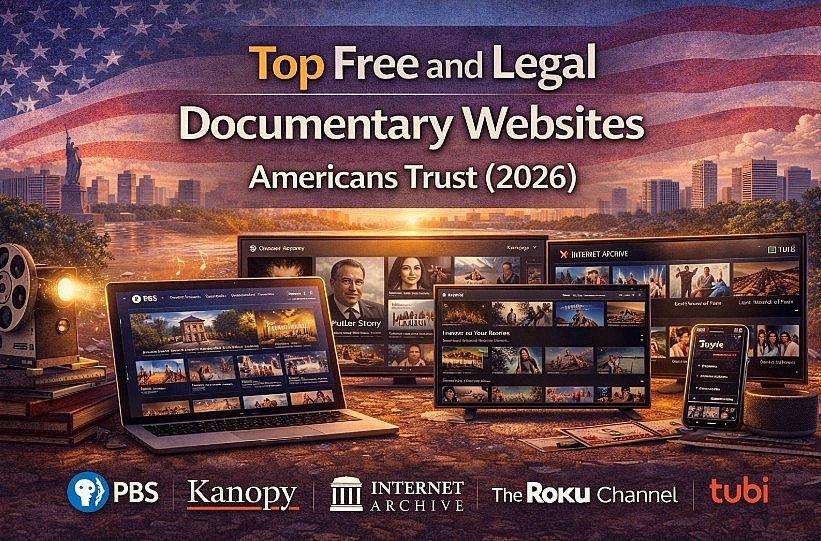
Top 5 Free and Legal Documentary Websites Americans Trust

 |
| Top documentary websites Americans trust |
Documentaries hold a special place in American viewing habits. They’re used in schools, libraries, living rooms, and even workplaces. But unlike movies or TV shows, documentaries demand trustworthy sources, clear licensing, and accurate information.
This guide highlights the best free and legal documentary websites Americans actually trust in 2026, based on educational value, platform credibility, and long-term reliability—not hype or loopholes.
Why Documentary Viewers Care More About Legality
Unlike entertainment content, documentaries are often used for:
-
Education and research
-
News and current affairs
-
Cultural and historical understanding
That’s why Americans tend to favor public broadcasters, libraries, and nonprofit archives when watching documentaries for free. These platforms prioritize accuracy, ethics, and lawful distribution.
How These Platforms Were Selected
Each website below meets strict criteria:
-
Fully legal operation in the United States
-
Clear licensing or library-based access
-
Free viewing (no trials or hidden fees)
-
Strong reputation among US viewers
-
Stable, long-term availability
Read more:
- Top 20 Best Documentary Movies on Netflix You Must Watch
- Top 10 Best Free Sites To Watch & Download Documentaries (Legally)
- Top 10 Most Popular Netflix True Crime Documentaries
1. PBS
Most trusted source for high-quality documentaries
PBS is the gold standard for documentary content in the US. Its programs focus on history, science, nature, social issues, and current affairs. Many full documentaries are available to stream free.
-
Website: https://www.pbs.org
-
Best for: History, science, public affairs
-
Ads: Minimal or none
Why Americans trust it: PBS is publicly funded and editorially independent.
2. Kanopy
Best for educational and award-winning documentaries
Kanopy partners with public libraries and universities to offer thoughtful, academic documentaries. The catalog includes independent films, social issue docs, and festival favorites.
-
Website: https://www.kanopy.com
-
Access: Requires US library card
-
Best for: Education, students, in-depth topics
Why it stands out: No ads, no algorithms, no clickbait.
3. Internet Archive
Best for historical and archival documentaries
Internet Archive hosts millions of digitized films, including government documentaries, historical footage, and rare educational films. Many titles are available without an account.
-
Website: https://archive.org/details/movies
-
Best for: History, archival content
-
Ads: None
Why it matters: It preserves content that would otherwise disappear.
4. Tubi
Best for mainstream and casual documentaries
Tubi offers a large selection of documentary films alongside its movie catalog. Topics include crime, nature, pop culture, and biographies.
-
Website: https://tubitv.com
-
Best for: Easy, on-demand documentary viewing
-
Ads: Yes
Why Americans use it: Easy access and broad topic range.
5. The Roku Channel
Best for documentary collections on Smart TVs
The Roku Channel curates free documentary sections and live channels, making it convenient for Smart TV users.
-
Website: https://therokuchannel.roku.com
-
Best for: Living-room viewing
-
Ads: Yes
Why it’s useful: Built into millions of US TVs.
Comparison Table
| Platform | Best Use Case | Ads | Account Needed |
|---|---|---|---|
| PBS | Trusted educational docs | Minimal | No |
| Kanopy | Academic & indie docs | No | Library card |
| Internet Archive | Historical & archival | No | No |
| Tubi | Casual & popular docs | Yes | No |
| Roku Channel | TV-based viewing | Yes | No |
Which Platform Should You Choose?
-
For education and credibility: PBS or Kanopy
-
For historical research: Internet Archive
-
For casual viewing: Tubi
-
For Smart TV users: Roku Channel
Most Americans use two platforms together—one trusted source and one casual option.
FAQs
Are free documentary websites legal in the US?
Yes, if they operate through public broadcasters, libraries, or licensed ad-supported platforms like PBS, Kanopy, or Tubi.
Why do libraries offer documentaries for free?
US public libraries fund access to educational media as part of their public mission.
Do I need an account to watch documentaries for free?
Some platforms like PBS and Internet Archive don’t require accounts. Library services like Kanopy do.
Are free documentaries lower quality?
Not necessarily. Many award-winning and educational documentaries are free through trusted platforms.
Can I watch documentaries on Smart TVs?
Yes. PBS, Tubi, Kanopy, and The Roku Channel all support Smart TVs and streaming devices.
Final Thoughts
Free documentary streaming in the US isn’t about shortcuts. It’s about public access, education, and cultural preservation. By using trusted platforms, Americans can stay informed and curious—without subscriptions or legal risk.