MLS 2026 Format Explained: Conferences, 34-Game Schedule, Uneven Paths, and How to Read the Standings

 |
| MLS 2026 Explained: Conferences, the 34-Game Schedule, and Why Every Team’s Path Is Different |
If you’ve followed Major League Soccer for any length of time, you’ve probably felt this tension:
'MLS looks simple… until you actually try to compare teams'
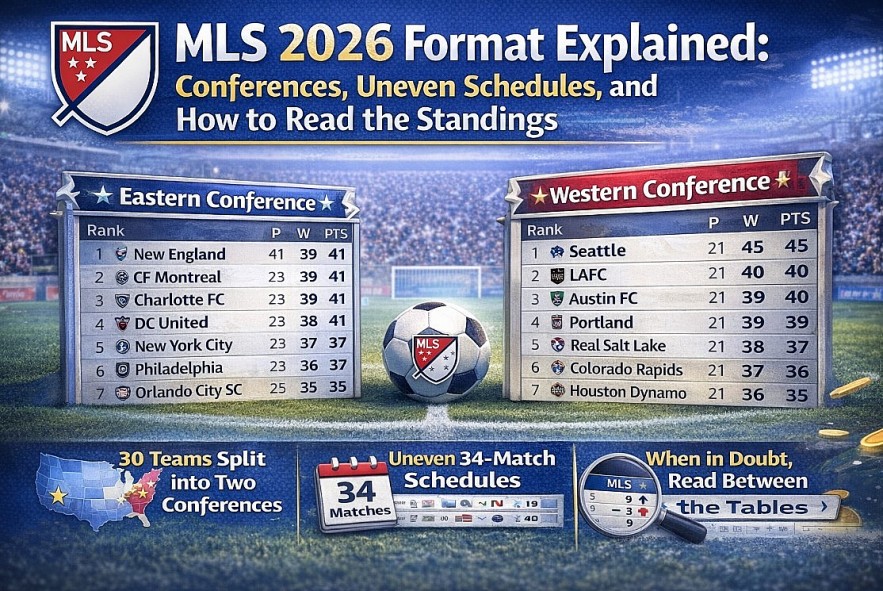
In 2026, that feeling intensifies. The league still plays a 34-game season, still uses Eastern and Western Conferences, and still sends nine teams per conference to the playoffs. But the combination of an unbalanced schedule and a long World Cup pause means the standings can lie to you if you don’t know how to read them.
This is the complete, no-nonsense guide to how the MLS 2026 format really works, why not all paths are equal, and how informed fans follow the league without falling into common traps.
Read more:
- Full List of All 30 MLS Teams in 2026: Founding, Owners, Titles, Stars, and Season Outlook
- How to Watch MLS 2026: Apple TV Subscription, End of MLS Season Pass
The foundation: two conferences, not one league table
MLS is not built like the Premier League or Bundesliga. It is best understood as two parallel competitions.
-
30 teams total
-
15 teams in the Eastern Conference
-
15 teams in the Western Conference
There is no balanced, league-wide round robin. Conference play is the organizing principle of the entire season.
That single fact explains:
-
Why schedules aren’t equal
-
Why cross-conference comparisons are shaky
-
Why playoff races feel more local than national
If you follow MLS as one giant table, frustration is guaranteed. Follow it as two conference races, and the league starts to make sense.
Why MLS plays 34 games — and why that creates imbalance
Each MLS team plays 34 regular-season matches. That number is fixed. What’s not fixed is who those matches are against.
How the 34 games are structured
-
The majority are conference games
Most teams play conference opponents home and away -
A smaller set are cross-conference games
You do not face every team from the other conference
This means:
-
Some teams face tougher conference slates
-
Some get more travel-heavy stretches
-
Strength of schedule varies every year
MLS accepts this trade-off intentionally. The league prioritizes:
-
Regional rivalries
-
Reduced travel
-
Clear playoff races
Perfect balance is sacrificed for identity and drama.
Why uneven schedules matter more in 2026
In a normal year, schedule imbalance is manageable. In 2026, it’s amplified.
MLS pauses league play from May 25 to July 16 for the World Cup. That splits the season into two distinct phases:
-
Phase One: February → late May
-
Phase Two: mid-July → November
Not every team reaches the pause having played the same opponents or the same mix of home and away matches. When the league restarts, some clubs are:
-
Done with their hardest stretch
-
About to enter it
-
Or reshaped entirely by injuries and roster moves
This is why early standings in 2026 are especially misleading.
Read more:
- MLS 2026 Season Preview: Dates, World Cup Pause, Apple TV Changes, and What US Fans Should Watch
- MLS 2026 Schedule Explained: Key Dates, World Cup Break, and What Fans Need to Know
The right way to read MLS standings (and the wrong way)
The wrong way
-
Sorting by total points
-
Comparing East vs West directly
-
Ignoring games played
The smart way
1) Start with conference position
Playoffs, seeding, and home advantage are all conference-based.
2) Use points per game, not total points
Especially before and after the World Cup pause, match counts vary.
3) Track the playoff cut line, not the leaders
The most meaningful race in MLS is usually places 6 through 11, not first place.
Experienced MLS fans don’t ask, “Who’s on top?”
They ask, “Who’s above or below the line?”
Cross-conference games: fewer, but strategically important
Cross-conference matches make up less than 20% of the schedule, but they still matter.
They can:
-
Swing tiebreakers late in the season
-
Affect Supporters’ Shield conversations
-
Serve as reality checks for contenders
For fans, these games feel different. They’re rarer, less familiar, and often more entertaining. But make no mistake: conference results decide playoff fate.
Why MLS rewards trend-watching over snapshot judging
MLS seasons are long, but information arrives in bursts. In 2026, the most valuable insights come from patterns, not positions.
Smart fans watch:
-
Five-game form, not one-week jumps
-
Home vs away splits
-
Post-restart performance after July 16
A team climbing slowly in August is often more dangerous than a team that peaked early in April.
A simple framework for following MLS 2026
If you want clarity without obsession, use this system:
-
Pick one conference to follow closely
-
Check standings once a week, not daily
-
Focus on points per game until September
-
Start watching head-to-head tiebreaks in October
MLS doesn’t reward constant refreshing. It rewards context.
FAQs
How many teams are in MLS in 2026?
30 teams, split evenly between Eastern and Western Conferences.
How many games does each MLS team play?
34 regular-season matches.
Do MLS teams play every other team?
No. The schedule is conference-heavy with limited cross-conference games.
Why do MLS standings feel uneven?
Because teams don’t play identical schedules, and the 2026 World Cup pause amplifies those differences.
Final takeaway
MLS 2026 isn’t broken. It’s designed differently.
The league values regional competition, playoff tension, and late-season drama over perfect symmetry. Once you stop treating MLS like a single-table league and start reading it as two evolving conference races, the noise fades and the story sharpens.
That understanding is the difference between being confused by MLS — and actually enjoying it.