How to Price Your Patreon Tiers in 2026: Smart Strategies That Actually Convert

 |
| How to Price Your Patreon Tiers |
Pricing your Patreon tiers isn’t about guessing what “sounds reasonable.” It’s about psychology, positioning, and understanding what your audience actually values. Many creators either underprice out of fear or overcomplicate their tiers and confuse potential supporters.
If you want sustainable growth, your pricing needs to do three things:
Lower the barrier to entry
Highlight clear value
Encourage upgrades naturally
Here’s how to do it the smart way.
Read more: How to Find 'Join for Free' on Patreon in 2026 (Even When It’s Hidden)
1. Start With a Low-Barrier Entry Tier
One of the biggest pricing mistakes creators make is starting too high. If your cheapest tier is $10, you’re forcing fans to think hard before committing.
A strong entry tier is usually:
-
$3 to $5 for general creators
-
$1 to $3 for large-audience creators using volume strategy
The goal of your lowest tier is not maximum profit. It’s conversion momentum. Once someone becomes a paying member, they’re far more likely to upgrade later.
Think of your lowest tier as your “Yes, I support you” button.
2. Use the 3-Tier Model (It Converts Best)
While some creators build 6–8 tiers, simplicity often wins.
The most effective structure in 2026 remains:
-
Tier 1: Entry support tier
-
Tier 2: Core value tier
-
Tier 3: Premium experience tier
Why this works:
-
Too many options cause decision fatigue.
-
Three tiers create contrast without confusion.
-
It allows anchor pricing (explained below).
Unless you have a very specific reason, start with three tiers and optimize from there.
Read more: What Is a Patreon Viewer Tool, And Legit Alternatives
3. Apply Anchor Pricing Psychology
Anchor pricing means using a higher-priced tier to make your middle tier feel like the best value.
Example:
-
$5 – Supporter
-
$12 – Full Access
-
$25 – VIP + Bonus Access
Most members will choose the middle tier. The $25 tier makes $12 look reasonable.
Without that anchor, $12 might feel expensive. With it, $12 feels balanced.
This is not manipulation. It’s clarity through comparison.
4. Focus on Value Clarity, Not Feature Overload
More perks don’t automatically increase conversions. Clear benefits do.
Instead of writing:
“Behind-the-scenes content, extra posts, exclusive updates, community access…”
Write:
“1 exclusive podcast episode per week + early access to every public release.”
Specific beats vague every time.
Ask yourself:
-
Can someone understand the value in 5 seconds?
-
Does each tier clearly improve from the previous one?
If not, simplify.
5. Don’t Underprice Out of Fear
Many creators price too low because they’re afraid of rejection.
But pricing too low can:
-
Signal low value
-
Attract low-commitment members
-
Make income unsustainable
If your content takes serious time and skill, $8–$15 for core access is not unreasonable, especially for niche expertise (education, investing, professional insight).
Low pricing only works if you have large volume.
6. Test, Don’t Guess
Pricing is not permanent.
You can:
-
Add a new tier
-
Adjust benefits
-
Offer limited-time discounts
-
Grandfather existing members at old pricing
Instead of obsessing over the “perfect” price, launch with a logical structure and observe:
-
Conversion rate
-
Upgrade rate
-
Churn (cancellations)
If churn is high, the perceived value doesn’t match the price.
If upgrades are strong, your structure is working.
Read more: How to Join Patreon Free: Latest Guide to Free Membership Explained
7. Use Strategic Upgrade Triggers
Smart creators design tiers to encourage upward movement.
Examples:
-
“Full archive access” starts at Tier 2
-
Monthly live Q&A starts at Tier 3
-
Downloadable resources bundled in higher tiers
Each higher tier should unlock something meaningful, not just “more of the same.”
Upgrade logic must feel natural.
8. Avoid Over-Complex Reward Promises
Physical rewards (merch, shipping) increase complexity and costs. Many successful creators now focus on:
-
Digital exclusives
-
Community access
-
Early releases
-
Bonus content
Simpler models reduce burnout and improve retention.
9. Think Long-Term Revenue, Not One-Month Gains
A $5 member who stays for 12 months is more valuable than a $15 member who cancels after one month.
Retention matters more than initial price.
Ask:
-
Is this tier sustainable for me to deliver every month?
-
Will members feel consistent value?
If not, adjust before scaling.
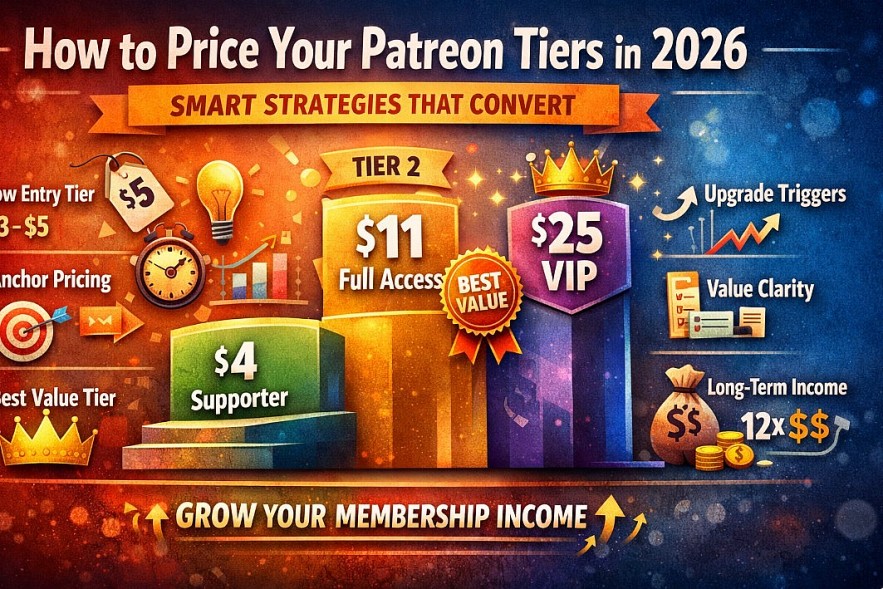
10. Realistic Example Tier Structure
Here’s a practical template:
Tier 1 – $4
Supporter
• Early access to content
• Community updates
Tier 2 – $11
Full Access
• Weekly exclusive content
• Archive access
• Member-only discussions
Tier 3 – $25
VIP
• Monthly live Q&A
• Behind-the-scenes deep dives
• Priority message responses
This structure:
-
Lowers entry friction
-
Anchors value
-
Encourages upgrades
Final Advice
Pricing your Patreon tiers is not about copying another creator’s numbers. It’s about matching your audience size, content type, and production capacity.
Keep it simple.
Be clear about value.
Use psychology ethically.
Optimize over time.
In 2026, the creators who succeed on Patreon are not the ones with the cheapest tiers — they’re the ones with the clearest value.