U.S. Students Studying Abroad: Top 10 Destination Countries and Why





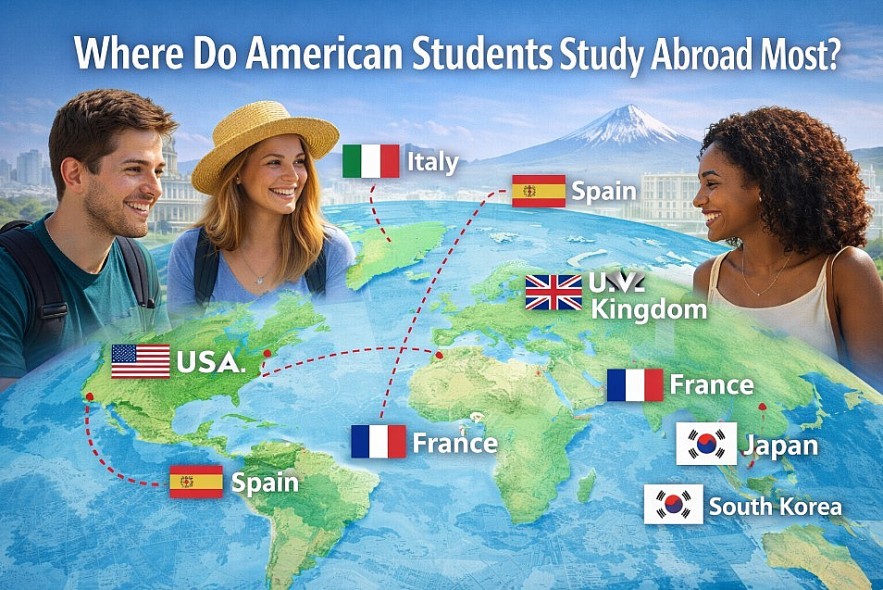 |
| Where do American students study abroad most |
As international mobility continues its post-pandemic recovery, American students are studying abroad in growing numbers—but with more strategic intent than ever before. Studying abroad is no longer viewed simply as cultural enrichment. For many U.S. students, it has become a deliberate academic and career decision shaped by cost, employability, and global exposure.
According to the most recent Open Doors 2025 report from the Institute of International Education (IIE), 298,180 U.S. studentsstudied abroad for academic credit in the 2023/24 academic year, an increase of just over 6% year over year. While this data reflects 2023/24, it is the latest official benchmark used by universities and policymakers to guide recruitment and program planning for 2025/2026 cohorts.
Despite rising participation, study abroad remains a minority experience: fewer than 10% of U.S. undergraduates participate during their degree. Among those who do, Europe dominates, hosting over 64% of all U.S. study abroad students.
Below are the Top 10 destination countries for U.S. students studying abroad, with destination share, key reasons for popularity, and what makes each country particularly suitable.
Read more: Why U.S. Students Are Studying Abroad: Trends, Destinations, And Majors
Top 10 Study Abroad Destinations for U.S. Students
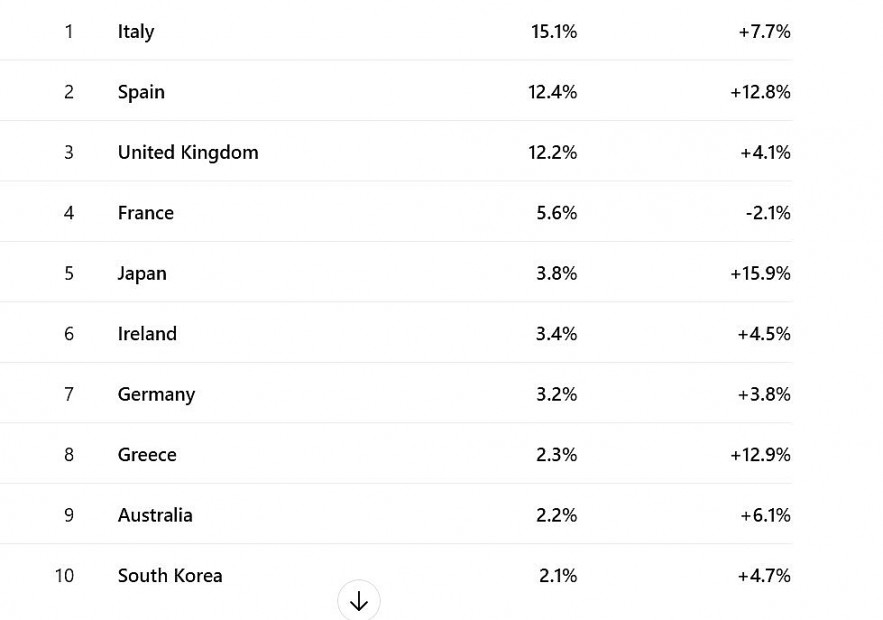 |
| Top 10 study abroad destinations for U.S. students |
1. Italy (≈15.1%)
Italy remains the number one destination for U.S. students by a wide margin. Its appeal lies in decades-long partnerships with American universities, a strong infrastructure for semester and summer programs, and unmatched cultural density. Italy fits the most common study abroad format: short- to mid-term, credit-bearing programs. Popular fields include humanities, business, international studies, art, and architecture. Cities such as Rome, Florence, Milan, and Bologna offer immersive learning environments that blend coursework with field-based experience.
2. Spain (≈12.4%)
Spain ranks second, driven by language acquisition, affordability, and student-friendly urban life. Spanish universities have expanded English-taught offerings, lowering barriers for students without advanced Spanish skills. Spain is especially popular for social sciences, public health, and business programs, with Madrid and Barcelona serving as major academic hubs.
3. United Kingdom (≈12.2%)
The UK remains a top choice due to its English-language instruction and globally recognized universities. Many U.S. students choose the UK for seamless credit transfer and academic alignment with their majors, particularly in social sciences, humanities, and data-oriented business fields. Rising costs have moderated growth, but prestige and familiarity keep the UK firmly in the top tier.
4. France (≈5.6%)
France continues to attract students interested in politics, international relations, business, and the arts. Institutions offering English-taught tracks make France accessible to non-French speakers, while Paris and regional cities provide diverse academic and cultural settings. A slight year-over-year decline reflects shifting student preferences rather than reduced relevance.
5. Japan (≈3.8%)
Japan is the fastest-growing major destination, entering the top five for the first time. Growth is fueled by student interest in technology, engineering, global business, and geopolitics, alongside expanded English-taught programs. Japan represents a broader pivot toward Asia among American students seeking strategic global exposure.
6. Ireland (≈3.4%)
Ireland appeals to students seeking an English-speaking experience within the EU. Strong ties to U.S. multinationals in technology, pharmaceuticals, and finance make Ireland attractive for career-oriented students, particularly in business and computer science. Post-study work options further strengthen its appeal.
7. Germany (≈3.2%)
Germany draws cost-conscious and STEM-focused students, especially at the graduate level. Low or no tuition at public universities, strong engineering and applied science programs, and Germany’s central location in Europe make it both academically and experientially appealing.
8. Greece (≈2.3%)
Greece has surged due to the expansion of short-term, faculty-led, and summer programs tailored to U.S. students. These programs often integrate coursework with historical and cultural field learning, making Greece ideal for high-impact, time-limited study abroad experiences.
9. Australia (≈2.2%)
Australia remains a high-quality, English-speaking destination with universities that closely resemble U.S. academic structures. Popular fields include environmental science, public health, and international relations. Geographic distance and travel costs keep participation lower than in Europe.
10. South Korea (≈2.1%)
South Korea reflects growing American interest in East Asian technology, business, and contemporary culture. Expanded English-taught programs, government scholarships, and strong exchange agreements have made Korea increasingly accessible, particularly for semester-long study.
What’s Changing for 2025/2026
Three major trends are shaping U.S. study abroad decisions:
-
Asia is growing faster than Europe, even as Europe remains dominant overall.
-
Semester-length programs are increasing, signaling demand for deeper academic value.
-
Career alignment is central: the most common majors among U.S. study abroad students are Business & Management (≈22%) and Social Sciences (≈18%).
Conclusion
For U.S. students, studying abroad is no longer just about travel or cultural curiosity. It is increasingly a strategic investment in education, skills, and global careers. Countries that combine academic quality, affordability, English-taught programs, and employability pathways are best positioned to attract the next generation of American students.