Russia Calendar 2026: Public Holidays, Festivals, and Orthodox Traditions

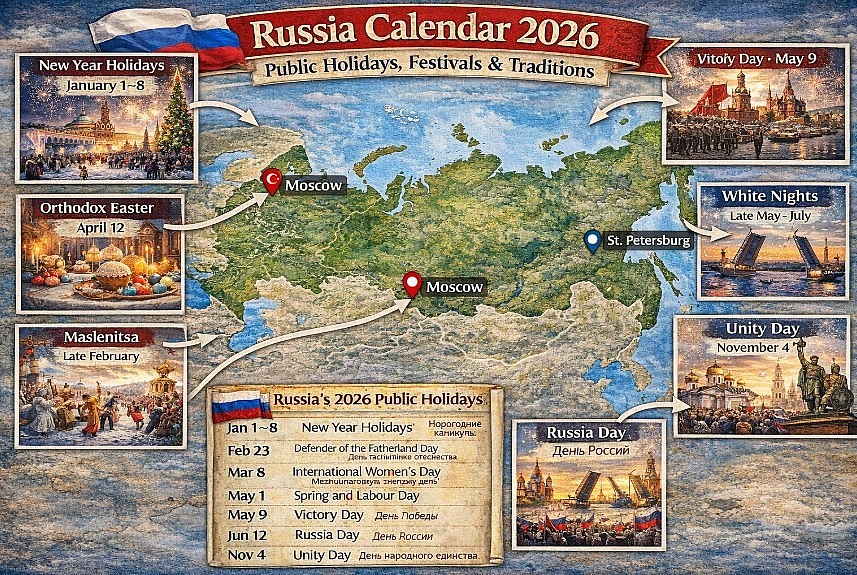 |
| Russia Calendar 2026: How Holidays and Festivals Shape the Russian Year |
Reading Russia Through Its Calendar
To understand Russia, one must understand how the country organizes time. Russia’s calendar reflects a layered identity shaped by state history, Orthodox Christianity, military memory, and strong seasonal contrasts. Holidays are not simply days off. They are markers of collective memory and national rhythm.
This article offers a comprehensive, verified, and narrative-driven overview of the Russia calendar for 2026, helping readers grasp not only the dates, but the meaning behind them.
How Public Holidays Work in Russia
Russia has a centralized national holiday system. Public holidays apply across the entire country, with no regional variation comparable to Spain or Germany.
Key features of the Russian holiday system:
-
Several holidays are grouped into multi-day national breaks
-
Holidays falling on weekends are often shifted to weekdays by government decree
-
Public institutions, schools, and many private companies close nationwide
-
Holiday periods strongly affect transportation and domestic travel
In 2026, Russia observes 8 official public holidays, many of which form extended breaks.
Unique Festivals and Cultural Events That Define RussiaWhat sets Russia apart from other countries is not just the number of public holidays, but the distinctive festivals that reflect its history, climate, and collective memory. These events are deeply rooted in tradition and cannot be fully replicated elsewhere. One of the most iconic Russian festivals is Maslenitsa, a centuries-old celebration marking the end of winter. Taking place in late February or early March, Maslenitsa combines ancient Slavic customs with Orthodox influences. Families gather to eat blini (thin pancakes symbolizing the sun), attend folk performances, and watch the ceremonial burning of a straw effigy. More than a festival, Maslenitsa represents renewal and resilience after the long Russian winter. Another event unique in both scale and meaning is Victory Day on May 9. In cities like Moscow, large military parades are matched by deeply personal acts of remembrance. Victory Day honors the Soviet victory in World War II and remains the most emotionally powerful date in the Russian calendar, blending national pride with collective mourning. Finally, the White Nights of Saint Petersburg offer a rare natural and cultural phenomenon. From late May to July, the city experiences almost continuous daylight, inspiring open-air concerts, ballet performances, and late-night festivals. The White Nights reflect Russia’s unique relationship with nature, space, and endurance. Together, these events define Russia’s calendar not as a series of days off, but as a living expression of identity and history. |
Official Public Holidays in Russia 2026
Table: Russia Public Holidays 2026
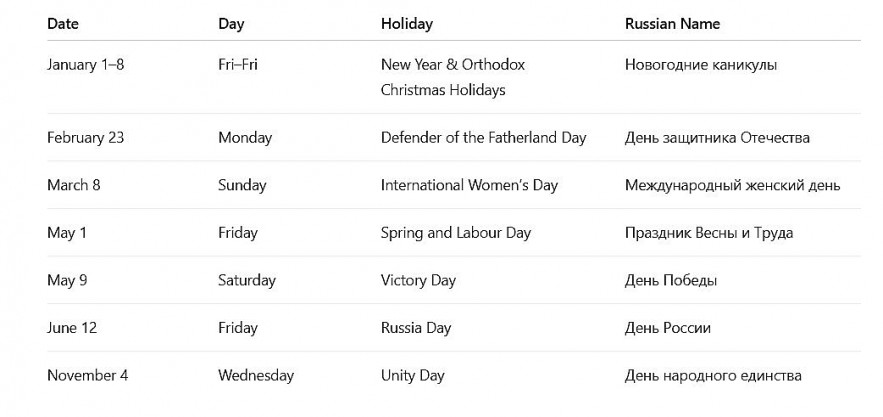 |
| Russia Public Holidays 2026 |
Note: The New Year holiday period (January 1–8) is the longest continuous public holiday in Russia and defines the country’s winter rhythm.
January: The Long New Year Pause
Russia begins the year differently from most countries. From January 1 to January 8, the country largely shuts down.
This period combines:
-
New Year celebrations
-
Orthodox Christmas (January 7)
-
Family gatherings and domestic travel
Business activity resumes slowly after January 8. For outsiders, this extended pause is one of the most distinctive features of the Russian calendar.
February–March: Winter Traditions and Social Celebrations
Defender of the Fatherland Day – February 23
Originally a military holiday, this day has evolved into a broader celebration of men and service. It is widely observed across workplaces and families.
International Women’s Day – March 8
Celebrated nationwide with flowers, gifts, and social gatherings, Women’s Day remains one of Russia’s most popular holidays, regardless of its political origins.
Maslenitsa: Russia’s Most Beloved Folk Festival
Maslenitsa, the traditional Slavic festival marking the end of winter, usually falls in late February or early March (in 2026, around late February).
Key features include:
-
Pancakes (blini) symbolizing the sun
-
Folk music and dancing
-
The ceremonial burning of a straw effigy
Maslenitsa bridges pagan tradition and Orthodox culture and is one of the most emotionally resonant celebrations in Russia.
Spring and Victory: May as a National Statement
Spring and Labour Day – May 1
A legacy of the Soviet era, May 1 remains a public holiday focused on leisure rather than ideology.
Victory Day – May 9
Victory Day is the most important civic holiday in modern Russia.
In cities such as Moscow, the day is marked by:
-
Military parades on Red Square
-
Nationwide remembrance ceremonies
-
Family commemorations honoring World War II veterans
Victory Day is not festive in a casual sense. It is solemn, emotional, and central to Russian national identity.
Orthodox Easter 2026
Russia follows the Orthodox Christian calendar, meaning Easter often falls later than in Western Europe.
-
Orthodox Easter Sunday 2026: April 12
Although Easter is not a public holiday, it is widely observed with:
-
Midnight church services
-
Traditional foods such as kulich and dyed eggs
-
Family gatherings
The influence of Orthodoxy is cultural rather than administrative, but deeply felt.
Summer: Russia Day and Seasonal Contrast
Russia Day – June 12
Russia Day marks the modern Russian state and is celebrated with concerts, fireworks, and public events.
In Saint Petersburg, this period often overlaps with one of Russia’s most famous seasonal phenomena.
White Nights: Culture Without Darkness
From late May to July, northern Russia experiences the White Nights, when the sun barely sets.
In Saint Petersburg, this season brings:
-
Outdoor concerts
-
Ballet and opera festivals
-
The White Nights Festival at the Mariinsky Theatre
While not a public holiday, White Nights shape Russia’s cultural calendar as powerfully as any official date.
November: Unity Day and Historical Memory
Unity Day – November 4
Introduced in the 2000s, Unity Day commemorates national solidarity during a period of historical crisis in the 17th century.
It replaces the former Soviet-era November holiday and reflects Russia’s evolving historical narrative.
Practical Planning Insights for 2026
-
Businesses: Expect near-total shutdown during early January
-
Travelers: Book early for May 9 and summer White Nights
-
Expats: Learn to plan around multi-day holiday blocks
-
International partners: Avoid critical deadlines in early January and early May
Understanding Russia’s calendar is essential for realistic scheduling.
Final Perspective
The Russia Calendar 2026 is marked by long pauses, emotionally charged commemorations, and deeply rooted traditions. With extended New Year holidays, the centrality of Victory Day, and Orthodox cultural rhythms, it offers a clear insight into how Russia lives, remembers, and resets itself each year.
To understand Russia in 2026, one must read its calendar carefully.