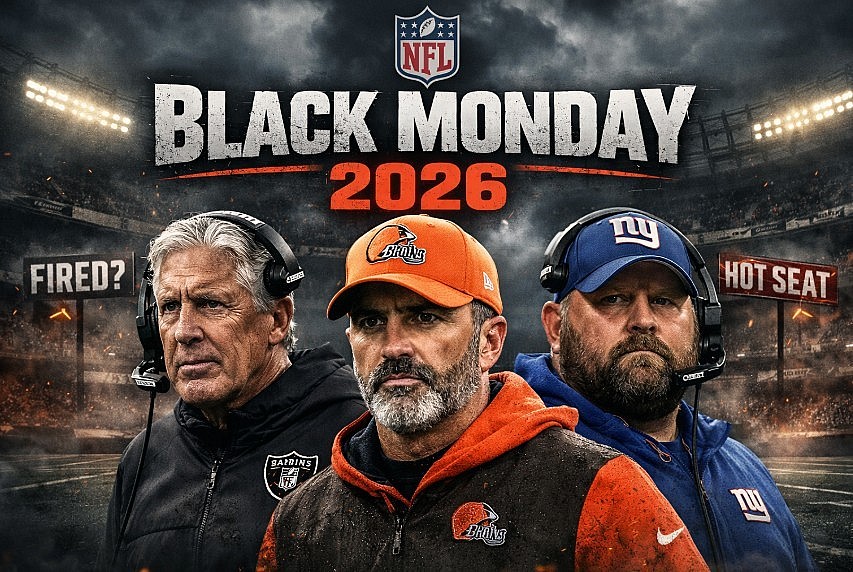
NFL Black Monday 2026 Explained: Which Head Coaches Are Most Likely to Be Fired




 |
| NFL firing rumors: Hot Seats for Black Monday |
What Is NFL Black Monday and Why It Still Matters in 2026
In the National Football League, Black Monday refers to the Monday immediately following the end of the regular season, when teams evaluate the entire year and make decisive leadership changes. While coaching firings now occur throughout the calendar, Black Monday remains the symbolic and strategic reset point for struggling franchises.
The importance of Black Monday has actually increased. Teams want early access to top coaching candidates, control over staff-building timelines, and clarity before free agency and the NFL Draft. Waiting too long can mean losing out in a competitive hiring cycle.
In 2026, Black Monday arrives amid rising offensive expectations, shorter rebuild windows, and owners increasingly unwilling to tolerate mediocrity.
Read more:
- Top NFL Head Coaching Candidates to Watch in the 2026 Cycle
- NFL Black Monday 2026: Matching Coaching Candidates to the Teams Most Likely to Make a Change
What Actually Drives Black Monday Decisions
Black Monday firings are rarely about one bad season. They reflect a broader calculus:
-
Expectation vs. outcome: Did the team meet realistic preseason goals?
-
Quarterback development: NFL owners prioritize offensive growth above all else.
-
Competitive trajectory: Is the team improving, plateauing, or regressing?
-
Market pressure: Big-market teams move faster under fan and media scrutiny.
-
Timing and opportunity: Availability of elite coaching candidates matters.
In 2026, coaches who fail to adapt offensively or maximize quarterback play face the shortest leashes.
Head Coaches on the Black Monday 2026 Hot Seat
(Ranked from highest to lowest risk, based on performance, expectations, and organizational context)
1. Pete Carroll – Las Vegas Raiders
Risk Level: Extremely High
Carroll’s tenure with the Raiders has quickly unraveled. The team finished near the bottom of the standings, ranking poorly in scoring defense and failing to establish a consistent offensive identity. Quarterback instability, penalty issues, and late-game collapses defined the season.
For a franchise desperate to modernize and compete in a brutal AFC, patience is thin. Carroll’s age, short-term contract outlook, and lack of tangible progress make him the most vulnerable coach entering Black Monday 2026.
2. Kevin Stefanski – Cleveland Browns
Risk Level: Very High
Stefanski’s résumé includes past Coach of the Year honors, but recent results have shifted the narrative. Cleveland entered the season with playoff expectations and finished well short of them.
The Browns struggled offensively, particularly in situational football, and failed to maximize a talented roster. Ownership now faces a familiar question: is instability the problem, or is this simply the ceiling under Stefanski?
Given the investment in the roster and quarterback position, another disappointing year is difficult to justify, placing Stefanski squarely on the hot seat.
3. Brian Daboll – New York Giants
Risk Level: High
Daboll’s early success has faded, replaced by regression on offense and stalled quarterback development. The Giants’ lack of scoring punch and repeated second-half breakdowns raised alarms across the organization.
In New York, optics matter. Fan frustration, media scrutiny, and a lack of visible progress accelerate decision-making. If ownership believes the roster is underperforming relative to talent, Daboll could become a Black Monday casualty.
4. Matt LaFleur – Green Bay Packers
Risk Level: Medium
LaFleur’s overall winning percentage protects him, but the trend line is concerning. Green Bay’s offense lacked consistency, and the team failed to establish itself as a legitimate postseason threat.
The Packers value stability, but expectations remain championship-driven. A coaching change would be bold, not inevitable. Still, another stagnant season could force a philosophical reset.
5. Raheem Morris – Atlanta Falcons
Risk Level: Medium-Low
Atlanta showed late-season improvement, which works in Morris’ favor. However, the Falcons missed opportunities in a winnable division and struggled with week-to-week consistency.
Ownership must weigh incremental progress against the risk of settling for mediocrity. Morris is safer than most, but far from untouchable.
6. Mike McDaniel – Miami Dolphins
Risk Level: Low
McDaniel remains respected leaguewide for his offensive creativity. Miami’s issue has been sustainability against elite competition, not overall direction.
Unless ownership demands a dramatic shift, McDaniel is expected to return. However, expectations will be higher than ever in 2026.
Final Words
NFL Black Monday 2026 is shaping up to be a defining moment for several franchises. While not every coach on the hot seat will be fired, multiple teams appear poised for change, driven by urgency, financial investment, and competitive pressure.
For some head coaches, Monday will mark more than the end of a season. It will mark the end of an era.