How Many Babies Were Born and How Many Died in America This Year




 |
| For every 100 births, the U.S. recorded about 85 deaths, leaving a relatively small margin for natural growth. |
New national data continue to show a slowing populationgrowth in the United States, driven by shifting birth and death patterns as well as changes in migration. According to provisional figures from the U.S. Census Bureau and demographic estimates, the U.S. still sees thousands more babies born annually than deaths, but the gap is narrowing.
Births and Deaths in Numbers
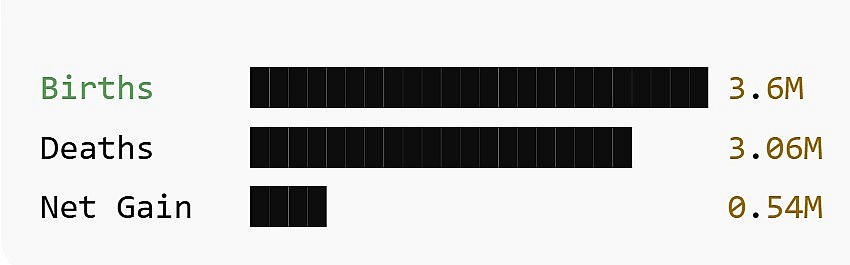
In 2025, the estimated number of live births in the United States was about 3,604,640, while the total number of deaths was around 3,060,888. That results in a natural increase of roughly 543,752 people (births minus deaths) over the full year.
These figures show:
-
About 3.6 million babies were born in the U.S. in 2025.
-
Around 3.06 million Americans died during the same period.
-
The natural population increase (births minus deaths) remained positive but modest.
On average, this translates into a birth roughly every 9 seconds and a death every 9.4 seconds, based on broader Census estimates.
Read more: Top 10 Largest Cities in North America in 2026 by Population
 |
| Births still lead, but by a much thinner margin than before |
Slowing Growth, Changing Trends
Even though births still outnumber deaths, the pace of natural growth has slowed compared with past decades. Census Bureau press releases and reporting note that U.S. population growth in the year ending mid-2025 was only 0.5%, one of the slowest rates in years.
The small natural increase is partly due to:
-
A declining fertility rate among younger women, with more choosing to delay having children or remain childless longer.
-
An aging population, where death counts remain relatively high compared to births in some regions.
-
Large changes in immigration, which now plays a bigger role in total population growth than natural increase.
What It Means for the U.S.
These dynamics suggest that:
-
Natural population growth is not as strong a driver of overall demographic increases as before.
-
Immigration and internal migration patterns have outsized influence on total growth figures.
-
Policy makers and planners must consider slower birth rates when looking at future workforce, healthcare, and education planning.
Bottom Line
Even with more births than deaths in 2025, the gap is narrowing. The U.S. added about half a million more people through natural increase, but that alone barely sustained growth compared to previous decades. Combined with migration shifts, these trends are reshaping America’s demographic future.
FAQs
How many babies are born in the U.S. each year?
In 2025, the U.S. recorded approximately 3.6 million live births, or nearly 10,000 babies per day.
How many people die in the U.S. each year?
About 3.06 million deaths were recorded in 2025, averaging more than 8,000 deaths per day.
Is the U.S. population still growing naturally?
Yes, but barely. Births exceeded deaths by only about half a million people, one of the smallest natural increases on record.
Why is population growth slowing?
Lower birth rates, delayed parenthood, and an aging population have reduced natural growth. Immigration now plays a larger role than births.
Could the U.S. see more deaths than births in the future?
Some states already do. At the national level, experts say this could happen if fertility continues to decline and immigration slows.