Top 10 Largest Cities in North America in 2026 by Population

 Top 25 Largest Cities in the World by Population in 2025 Top 25 Largest Cities in the World by Population in 2025 |
 Top 25 Largest Cities in the U.S. by Population in 2025 Top 25 Largest Cities in the U.S. by Population in 2025 |
 Top 10 Largest Cities in New York State: Population & Growth Insights Top 10 Largest Cities in New York State: Population & Growth Insights |
North America is home to some of the world’s most influential cities. From global financial hubs to fast-growing Latin American megacities, the continent’s largest urban centers shape economic trends, migration flows, and cultural influence far beyond their borders.
More than just numbers, these cities reflect how urban growth, opportunity, and power are distributed across the continent.
Read more: Top 10 Largest Cities in the United States by Population (2026)
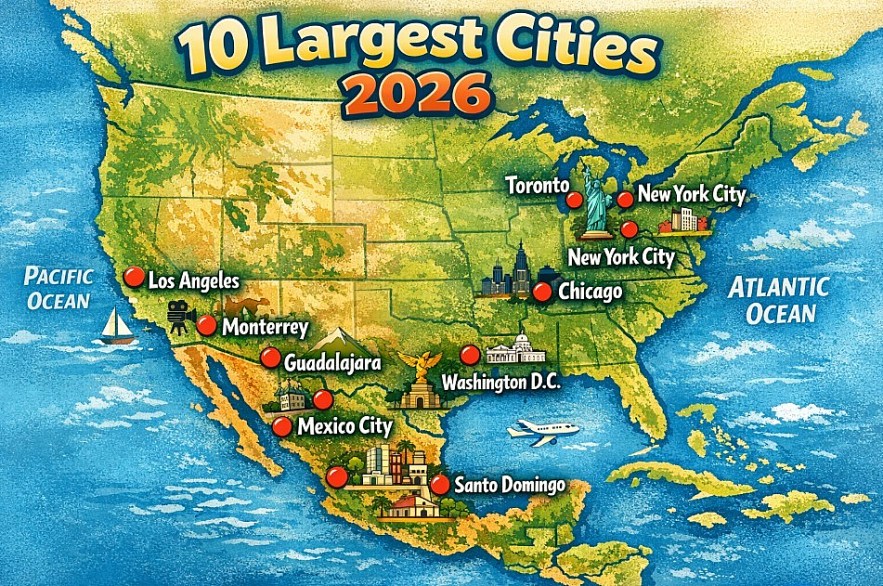 |
| 10 Largest Cities in North America in 2026: Where Population, Power, and Influence Converge |
1. Mexico City — ~17.7 Million
Mexico City stands firmly at number one, making it the largest city in North America by a wide margin. As the political, economic, and cultural heart of Mexico, the city combines centuries of history with modern megacity scale.
Its massive population is fueled by domestic migration, economic centralization, and a diversified economy spanning finance, manufacturing, media, and tourism. While infrastructure strain and air quality remain challenges, Mexico City’s influence across Latin America continues to expand.
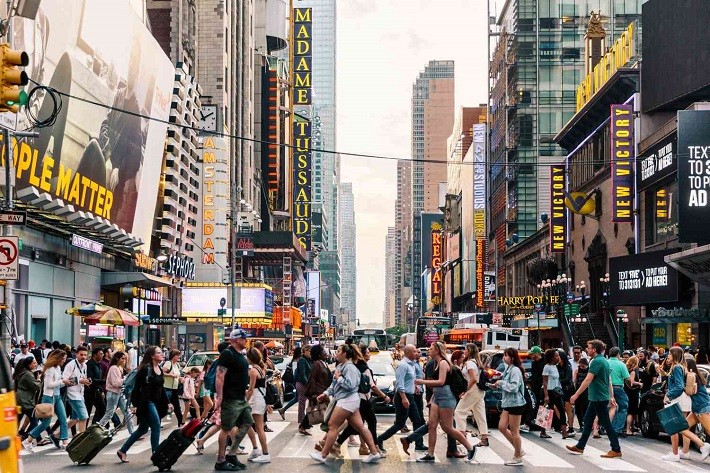
2. New York City — ~13.9 Million
New York City remains the most populous city in the United States and one of the most globally connected urban centers on Earth. As a financial, cultural, and media capital, NYC plays a unique role in shaping global markets, trends, and narratives.
Despite slower population growth compared to Sun Belt cities, New York’s density, diversity, and economic gravity keep it firmly near the top of North America’s urban hierarchy.
3. Los Angeles — ~12.7 Million
Los Angeles ranks third, reflecting its vast urban footprint and global cultural reach. Home to Hollywood, major ports, and a rapidly expanding tech scene, LA’s influence extends far beyond the United States.
Its growth has been moderated by housing costs and congestion, yet Los Angeles remains a magnet for talent, creativity, and international trade.
4. Toronto — ~5.5 Million
Toronto is Canada’s largest city and fastest-growing major urban center. Fueled largely by immigration, it has become one of the most multicultural cities in the world.
As Canada’s financial capital, Toronto plays a central role in banking, technology, education, and real estate, positioning it as a key North American city for the next decade.
5. Santo Domingo — ~4.6 Million
Santo Domingo’s place in the top five highlights the rising demographic importance of the Caribbean. As the Dominican Republic’s capital, it has experienced rapid population growth driven by urbanization, tourism, and economic diversification.
Its inclusion underscores that North America’s urban future is not defined by the U.S. and Canada alone.
6. Guadalajara — ~4.1 Million
Often described as Mexico’s cultural capital, Guadalajara blends tradition with innovation. In recent years, it has emerged as a regional tech hub, earning the nickname “Mexico’s Silicon Valley.”
The city’s youthful population and expanding startup ecosystem continue to attract investment and talent.
7. Houston — ~4.0 Million
Houston is the largest city in Texas and one of the most economically resilient cities in the United States. Known globally for energy, healthcare, and aerospace, it also stands out for its relative housing affordability.
This combination continues to draw new residents from across the country and abroad.
8. Monterrey — ~3.9 Million
Monterrey is Mexico’s industrial powerhouse. Strategically located near the U.S. border, it benefits from strong manufacturing, logistics, and trade connections.
Its business-friendly environment and high productivity make it one of Latin America’s most competitive urban economies.
9. Chicago — ~3.7 Million
Chicago remains a cornerstone of the U.S. Midwest. With strengths in finance, transportation, manufacturing, and higher education, it continues to function as a critical national and continental hub.
Its central location reinforces its role as a logistical and commercial gateway.
10. Washington, D.C. — ~3.3 Million
Rounding out the top ten, Washington, D.C. is unique for its political significance. As the capital of the United States, its influence extends through governance, diplomacy, and global policy-making.
Population growth here is closely tied to federal employment, international institutions, and surrounding metropolitan expansion.
Why These Rankings Matter
The top 10 largest cities in North America reveal clear trends:
-
Latin American megacities dominate population size
-
Immigration is the primary growth driver in Canada
-
Economic opportunity continues to reshape U.S. urban patterns
Understanding these cities offers valuable insight into where people, capital, and influence are concentrating in 2026.