France Calendar 2026: Public Holidays, Festivals, and the Cultural Rhythm of France

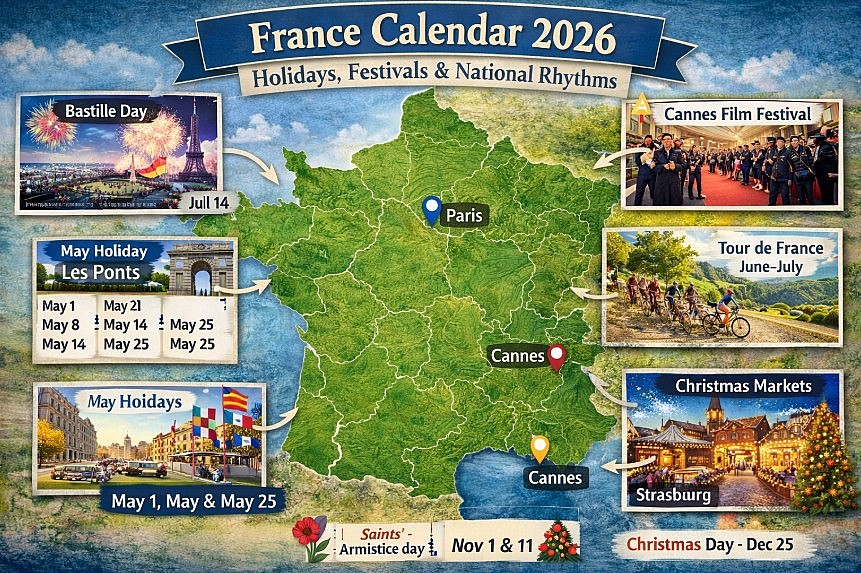 |
| France Calendar 2026 |
Reading France Through Its Calendar
To truly understand France, one must look beyond politics, cuisine, or art and examine something more subtle: how the country organizes time. The French calendar is not merely administrative. It is cultural infrastructure. It determines when France accelerates, when it fragments, and when it slows almost to a standstill.
In 2026, France follows a familiar pattern shaped by 11 national public holidays, a dense concentration of breaks in spring, a symbolic national day in July, and a uniquely French summer pause in August. Layered on top of this structure are festivals and cultural events whose influence often exceeds that of official holidays.
This article offers a comprehensive, verified, and journalistic overview of the France calendar in 2026, combining factual accuracy with cultural context to give readers a clear, realistic picture of how the French year actually unfolds.
Read more: Can France Reclaim the Statue of Liberty?
How Public Holidays Work in France
France applies its public holidays nationwide, with no regional variation. However, the legal and social impact of these days differs from many other countries.
Key characteristics:
-
11 national public holidays in 2026
-
No automatic day off when a holiday falls on a weekend
-
Only Labour Day (May 1) is legally mandatory as a paid day off for most employees
-
In practice, many businesses, schools, and public services close on most holidays
The result is a system where timing and cultural behavior matter more than the raw number of holidays.
France’s National Public Holidays 2026
Total: 11 national public holidays
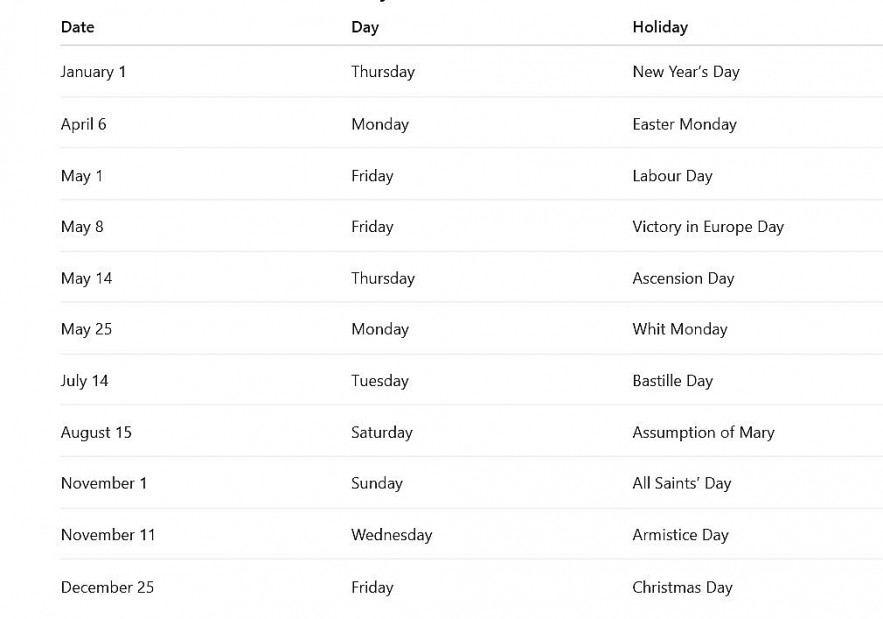 |
| France’s National Public Holidays 2026 |
January to April: A Controlled Start to the Year
France begins 2026 without drama. After New Year’s Day, the country returns quickly to work. There is no extended winter shutdown, reflecting a French preference for structured continuity rather than prolonged breaks.
Spring introduces Easter, with Easter Monday (April 6) as the official holiday. While religious observance is more discreet than in southern Europe, Easter still marks a seasonal turning point. Domestic travel increases, families gather, and cultural institutions begin preparing for peak visitor months.
May: The Month That Redefines Productivity
If one month defines the French calendar, it is May.
In 2026, May contains four public holidays, strategically positioned:
-
May 1 (Friday) – Labour Day
-
May 8 (Friday) – Victory Day
-
May 14 (Thursday) – Ascension Day
-
May 25 (Monday) – Whit Monday
This alignment fuels the uniquely French practice of faire le pont—taking a “bridge day” between a holiday and a weekend. Entire weeks become fragmented. Offices operate with skeleton staff. Decision-making slows.
For international companies, May is the most operationally unpredictable month in France. For French workers, it is a celebrated expression of work–life balance.
Bastille Day: July 14 and the Republic on Display
Bastille Day, celebrated on July 14, is the emotional and symbolic core of the French calendar.
In Paris, the day unfolds with ritual and scale:
-
A military parade on the Champs-Élysées, the oldest continuous parade in Europe
-
Fireworks at the Eiffel Tower, broadcast worldwide
-
Public dances (bals des pompiers) in neighborhoods across the country
Unlike many national days, Bastille Day is not nostalgic. It is assertively civic, reaffirming the ideals of liberty, equality, and fraternity. For France’s global image, no date carries greater symbolic weight.
Summer in France: The August Phenomenon
Understanding France means understanding August.
Although Assumption Day (August 15) falls on a Saturday in 2026, August remains a de facto national slowdown. Entire sectors close. Administrative processes pause. Paris empties as coastal and rural regions fill.
This is not a logistical failure. It is a cultural choice, broadly accepted and socially protected.
Anyone working with France—investors, partners, or clients—must plan around August. Expect delayed responses and limited availability.
Cultural Power Beyond Public Holidays
Cannes Film Festival
Held each May in Cannes, the Cannes Film Festival is one of France’s most powerful instruments of cultural influence. It shapes global cinema trends, dominates international media, and temporarily transforms the Riviera economy.
Though not a public holiday, its economic and symbolic impact rivals that of one.
Tour de France
From late June into July, the Tour de France turns the entire country into a moving narrative. More than a sporting event, it is a celebration of:
-
Geography and regional identity
-
Rural heritage
-
National endurance and spectacle
For many regions, it is the most economically significant event of the year.
Christmas Markets and the Alsace Tradition
As winter approaches, eastern France—particularly Strasbourg—becomes synonymous with Christmas markets. These emphasize craftsmanship, tradition, and community over commercial excess.
November and December: Memory, Closure, and Continuity
All Saints’ Day (November 1) and Armistice Day (November 11) anchor the autumn in remembrance. These are reflective holidays, marked by ceremonies rather than celebration.
Christmas Day (December 25) closes the year quietly. Offices shut. Travel slows. Family life takes precedence. France ends the year as it began it: deliberately.
Why the France Calendar 2026 Matters
France’s calendar explains:
-
Why May feels fragmented
-
Why August feels unreachable
-
Why July 14 remains emotionally potent
-
Why work and leisure are treated as complementary, not opposing forces
For travelers, it shapes crowds and costs.
For businesses, it defines rhythm and risk.
For observers, it reveals what France values most.
Final Perspective
The France Calendar 2026 is not generous in number, but it is rich in meaning. With 11 national public holidays, globally influential festivals, and a deeply ingrained seasonal cadence, it offers a clear portrait of a nation that organizes time with intention.
To read the French calendar is, in many ways, to understand France itself.