Will Schools Close? What Families in Storm-Hit States Need to Know

 |
| No Snow Day, Remote Learning Instead |
As a massive winter storm continues to batter large parts of the United States with snow, ice, and dangerous cold, millions of parents are asking a familiar but newly complicated question: Will schools close on Monday, January 26, 2026 — or will students be expected to log in from home?
In many places, the answer is already becoming clear: the traditional snow day is no longer guaranteed, even during major storms. Instead, remote learning is increasingly the default, especially in large urban districts.
NYC Makes It Official: No Snow Day, Remote Learning Instead
New York City, the nation’s largest school district, is setting the tone.
On Friday, Zohran Mamdani announced that New York City public school students will not receive a traditional snow day on Monday, even if the city is blanketed with heavy snow. Instead, students will be expected to log in for remote learning.
City officials said the decision reflects New York’s expanded capacity for virtual instruction and an effort to avoid further disruptions to the academic calendar. In recent years, NYC has largely eliminated snow days in favor of online learning when weather conditions make in-person classes unsafe.
For parents, the announcement provides clarity — but also frustration.
Many families note that remote learning during snowstorms can be challenging, especially if power outages, internet disruptions, or childcare issues arise while parents are also working from home.
Read more:
- Snow Day or Remote Learning? What Parents Should Really Expect During Major Winter Storms
- Snow Days vs. Remote Learning in the U.S.: How the 10 Largest States Handle School Closures
- Snow Days vs. Remote Learning: How School Closures Work Across Different U.S. States
Why Monday Is a Critical Decision Point Nationwide
Winter storms that peak over the weekend often leave lingering hazards that directly affect Monday school operations:
-
Snow-covered secondary roads and sidewalks
-
Overnight refreezing as temperatures plunge
-
Delayed snow removal in suburban and rural areas
-
Power outages caused by ice and wind
School districts rely heavily on updated guidance from the National Weather Service, along with early-morning reports from transportation and public works departments, before making final decisions.
Even if snowfall ends Sunday night, conditions early Monday morning may still be unsafe for buses and staff, particularly outside major cities.
What Parents Can Expect by Region
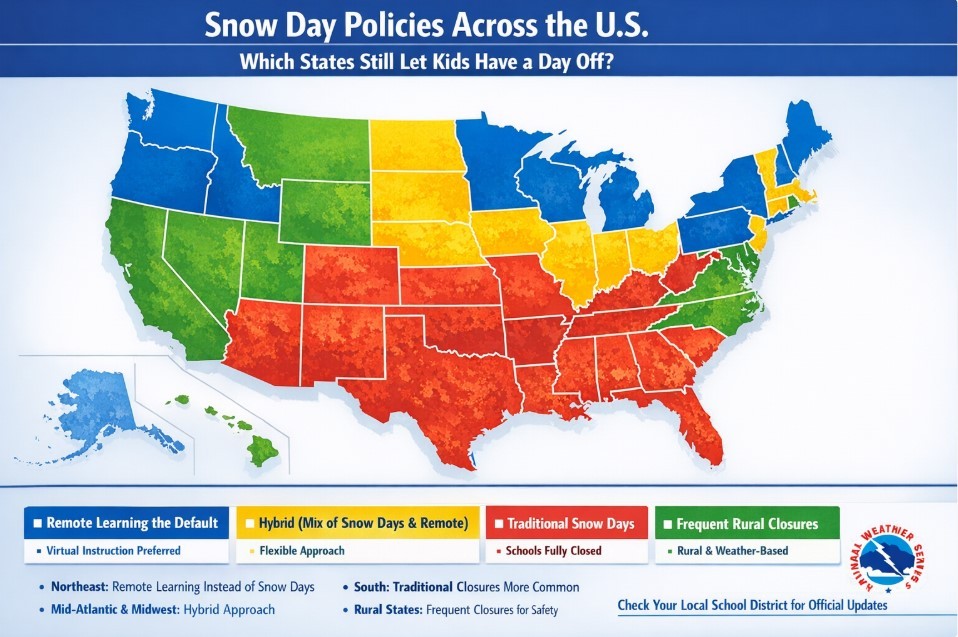
Northeast and Upper Midwest
In snow-prone states such as New York, Pennsylvania, Massachusetts, Michigan, and Minnesota, remote learning or delayed openings are increasingly likely. Large districts with strong snow-response systems are less inclined to cancel school outright.
NYC’s decision reinforces this trend: expect school to continue virtually unless conditions are extreme.
Mid-Atlantic (D.C., Maryland, Virginia)
The Mid-Atlantic remains a high-uncertainty zone. Where ice or mixed precipitation is involved, many districts are preparing for remote instruction on Monday, even with moderate snow totals. Two-hour delays are also common if conditions improve by mid-morning.
Southern States (Georgia, Texas, Tennessee)
In the South, full school closures remain more common, particularly during ice storms. Power outages and untreated roads often make both in-person and online learning impractical, leading districts to cancel classes altogether.
Why Snow Days Are Disappearing
Before the COVID-19 pandemic, districts relied on a limited number of built-in snow days. Once those were used, schools often had to extend the academic year.
Remote learning changed that calculation.
Today, many districts use “remote learning days” or “flexible instruction days” to avoid canceling school. Administrators argue this keeps students on track academically. Parents counter that it often ignores real-world storm conditions.
When Will Schools Announce Final Decisions?
Most districts aim to announce decisions:
-
Late Sunday night, or
-
Early Monday morning, often between 5 a.m. and 6 a.m.
Parents are advised to monitor:
-
Official school district emails and text alerts
-
District websites and social media channels
-
Local news and emergency management updates
What Parents Should Do Now
With uncertainty still high in many regions, experts recommend preparing for remote learning first, not a guaranteed day off.
Parents should:
-
Charge devices and backup batteries
-
Confirm login details and schedules
-
Plan childcare contingencies
-
Expect flexibility if power or internet issues occur
Most districts say students will not be penalized if widespread outages prevent participation.
The Bottom Line
As of now, many students across storm-affected states should expect either remote learning or delayed openings on Monday, Jan. 26, 2026, rather than a traditional snow day. New York City’s decision makes clear that, at least in major districts, remote learning is now the default response to severe winter weather.
Parents are urged to stay alert, prepare for last-minute changes, and assume that school may continue — even if the snow keeps falling.