When Is Summer Break in the U.S., and Why Is It So Long?

 |
| Summer Break in the United States: Dates, Duration, Origins, and the Ongoing Debate |
Each year, roughly 50 million K–12 students in the United States leave their classrooms and begin what is widely known as summer break. It is the longest pause in the American school calendar, shaping not only education but also family life, travel, youth employment, and even the economy.
Yet summer break in the U.S. is often misunderstood. There is no single start date, no fixed length, and no national rule. Instead, it is the result of history, climate, state laws, and local choices. This article provides a detailed, concrete, and up-to-date look at when summer break begins and ends, how long it lasts, why it varies, and why it remains one of the most debated features of American education.
Read more: School Holidays and Breaks in the US 2026: Key Dates, Schedules - Month by Month
When Does Summer Break Begin?
In the United States, summer break typically begins between May 20 and June 20, depending on location.
Regional patterns
-
Southern states (Florida, Texas, Georgia, Arizona):
Many districts end the school year in mid to late May. For example, large districts in Texas and Florida often schedule the last day between May 23–30. -
Western states (California, Nevada):
Most districts finish between early and mid-June, though some large urban districts now end in late May due to earlier August start dates. -
Midwestern and Northeastern states (Illinois, New York, Massachusetts):
The school year commonly runs into mid or even late June, with last days around June 15–25.
These differences exist because school calendars are set at the district level, not federally. States usually require a minimum number of instructional days (most often 180 days) or instructional hours, but they do not mandate exact dates.
How Long Is Summer Break, Exactly?
Across the country, summer break lasts an average of 10 to 12 weeks.
To be more precise:
-
Shortest typical breaks: about 8–9 weeks
-
Most common length: 10–11 weeks
-
Longest traditional breaks: 12–13 weeks
A student finishing school on May 25 and returning on August 10 has an 11-week break.
A student finishing on June 20 and returning on September 5 has a 10.5-week break.
Despite popular belief, American students do not attend fewer days of school overall than students in many other developed countries. The difference lies in how those days are distributed.
When Does Summer Break End?
The return to school usually falls between early August and early September.
Key patterns
-
Early August starts (Aug 1–10):
Common in the South and parts of the West. These districts often trade an earlier start for an earlier end in May. -
Mid-August starts (Aug 15–20):
Increasingly common nationwide, especially in large suburban districts. -
Post–Labor Day starts (early September):
Still common in parts of the Northeast and Upper Midwest, though the number of districts following this tradition has declined.
Over the past 20 years, the national trend has been clear: schools are starting earlier. In the 1990s, fewer than 25 percent of districts started before mid-August. Today, more than half do.
Earliest and Latest Summer Breaks
Looking at extremes highlights how flexible the system is:
-
Earliest end of school year:
Some districts finish as early as May 15–18. -
Latest return to school:
Districts that start after Labor Day may not resume until September 6–8.
This creates a possible summer break span of nearly 16 weeks from the earliest dismissal to the latest return, depending on where a student lives.
Read more:
- 2026 Florida Public School Calendar: Key Dates, Holidays, and What Families Should Know
- 2026 California Public School Calendar: Key Dates, Breaks, and What Parents Need to Know
-2026 New York Public School Calendar: Key Dates, Holidays & Breaks for NYC Students and Families
-2026 Texas Public School Calendar: Key Dates, Breaks, and What Families Should Know
Why Is Summer Break So Long? The Real Reasons
Historical Origins (Not Just Farming)
The long summer vacation took shape in the late 1800s, driven mainly by urban, not rural, concerns.
-
City schools closed during summer because classrooms were overcrowded, poorly ventilated, and dangerously hot.
-
Public health officials feared outbreaks of disease during warm months.
-
Wealthier families left cities in summer, reducing attendance.
By the early 20th century, this schedule became standardized and later adopted nationwide, even as air-conditioning and modern buildings changed conditions.
Climate and School Infrastructure
Even today, climate matters:
-
Thousands of older school buildings lack full air-conditioning.
-
Cooling schools during extreme heat can add significant costs.
-
In southern states, August temperatures regularly exceed 95°F (35°C).
Long breaks remain a practical solution in many regions.
Cultural and Economic Factors
Summer break supports:
-
A multibillion-dollar summer camp and youth travel industry
-
Seasonal employment for teenagers
-
Family travel aligned with adult vacation schedules
Over time, summer break became less a necessity and more a deeply rooted cultural expectation.
Why Do Some Schools Have Shorter Summer Breaks?
About 3–5 percent of U.S. public schools operate on year-round or balanced calendars.
These schools:
-
Still teach around 180 days per year
-
Limit summer break to 6–8 weeks
-
Add 2–4 shorter breaks during fall, winter, or spring
The goal is to reduce summer learning loss, the decline in academic skills during long breaks. Research consistently shows that students, especially in elementary grades, can lose 20–30 percent of yearly gains in math over a long summer.
However, adoption remains limited because year-round calendars:
-
Complicate childcare
-
Conflict with traditional summer programs
-
Create scheduling issues for families with children in different districts
Read more: Snow Days vs. Remote Learning: Which States Still Let Kids Have a Day Off?
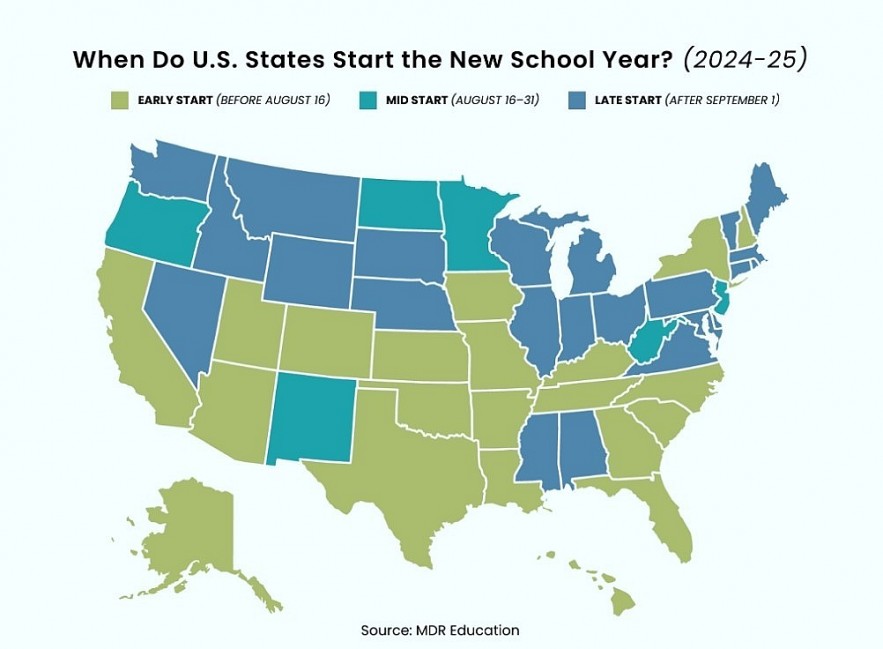 |
| Which states’ summer breaks end the earliest and latest |
The Central Debate: Benefits vs. Costs
Arguments Supporting a Long Summer Break
Supporters emphasize that:
-
Children benefit from unstructured time
-
Summer allows for creativity, social development, and rest
-
Teachers use summer for retraining or curriculum planning
-
Burnout is reduced for both students and staff
There is also growing recognition that not all learning needs to be academic.
Arguments Against It
Critics point to concrete problems:
-
Learning loss, especially in reading and math
-
Widening achievement gaps between income groups
-
Childcare costs that can exceed $1,000 per month per child
-
Increased food insecurity for students relying on school meals
These concerns have fueled calls to shorten summer break or restructure the school year.
How Families and Districts Adapt
Because eliminating summer break is politically unpopular, most reforms focus on mitigation:
-
Free or subsidized summer school programs
-
Library-based reading initiatives
-
Community sports and enrichment camps
-
Online review programs designed for light academic maintenance
After the COVID-19 pandemic, many districts expanded summer offerings, signaling a shift toward using summer more strategically rather than shortening it.
How the U.S. Compares Internationally
Compared to many developed countries:
-
The U.S. has one of the longest single summer breaks
-
Other systems favor shorter summers (5–7 weeks) plus more frequent breaks
The American approach reflects a preference for local control and tradition over centralized reform.
State-by-State Reality: When Summer Break Actually Starts and Ends
Typical Summer Break Dates by State (Selected Examples)
Southern States (Earlier Start, Earlier End)
Texas
-
Average last day of school: May 23–30
-
Average first day of next school year: August 10–15
-
Typical summer break length: 10–11 weeks
-
Legal note: Texas law allows districts to start no earlier than the second Monday of August, unless granted a waiver.
Florida
-
Average last day: May 25–31
-
Average return: August 10–15
-
Summer length: 10–11 weeks
-
Florida districts often prioritize early starts to complete standardized testing before late spring heat peaks.
Georgia
-
Average last day: May 22–29
-
Return: Early August (Aug 3–10)
-
Summer length: 9–10 weeks
-
Georgia requires 180 instructional days, but allows flexible calendar design.
Western States (Mid-Range, Increasingly Early Starts)
California
-
Average last day: June 5–15
-
Average return: August 15–20
-
Summer length: 9–10 weeks
-
Large districts (Los Angeles, San Diego) have shifted earlier since 2010 to align semester pacing.
Arizona
-
Average last day: May 20–25
-
Average return: Late July to early August
-
Summer length: 9–10 weeks
-
Heat mitigation and air-conditioning costs are major calendar factors.
Midwest (Moderate Start, Traditional Structure)
Illinois
-
Average last day: June 5–15
-
Average return: Mid to late August
-
Summer length: 10–11 weeks
-
Many districts build in snow days, pushing the end of the year later.
Ohio
-
Average last day: May 30–June 10
-
Return: Mid-August
-
Summer length: 10 weeks
-
Ohio mandates 1,001 instructional hours for grades 1–6.
Northeast (Later End, Later Start)
New York
-
Average last day: June 20–26
-
Return: September 5–8
-
Summer length: 10–11 weeks
-
New York City schools traditionally start after Labor Day.
Massachusetts
-
Average last day: June 18–25
-
Return: Early September
-
Summer length: 10–11 weeks
-
Many districts resist August starts due to heat and building age.
Pennsylvania
-
Average last day: June 5–15
-
Return: Late August or early September
-
Summer length: 10–12 weeks
-
Calendar influenced by agricultural fair schedules in rural districts.
Earliest and Latest Extremes (Verified Cases)
-
Earliest documented end of school year:
Mid-May (May 15–18) in parts of Arizona, Texas, and Florida. -
Latest documented start of school year:
After Labor Day (September 6–8) in districts in New York, New Jersey, and New England.
This creates a maximum possible summer span of nearly 16 weeks across the national system.
Instructional Days vs. Summer Length (Key Clarification)
Despite the long summer break, most states cluster tightly around the same annual instructional requirement:
| State | Required Instruction |
|---|---|
| Texas | 180 days |
| California | 180 days |
| New York | 180 days |
| Florida | 180 days |
| Ohio | 1,001 hours (≈180 days) |
The difference lies not in how much students learn per year, but in when those days occur.
The Bigger Picture
Summer break in the United States is not an accident, nor is it simply a relic of farming life. It is the result of historical conditions, climate realities, and cultural values that continue to shape education today.
While debates about its length and impact will continue, one fact remains clear: summer break is one of the most defining features of American childhood. Any serious conversation about changing it must balance academic outcomes with family life, economics, and the realities of local communities.