When Verizon Went Down, Public Safety Was Put at Risk

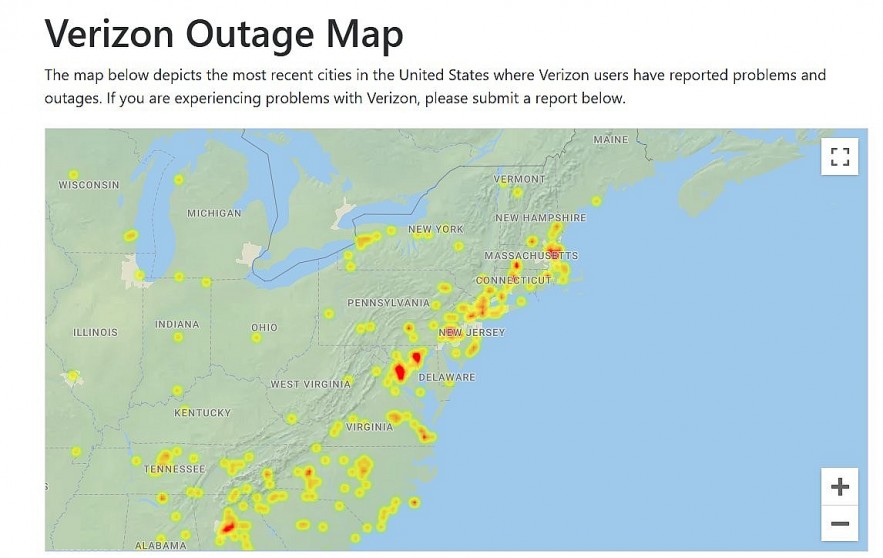 |
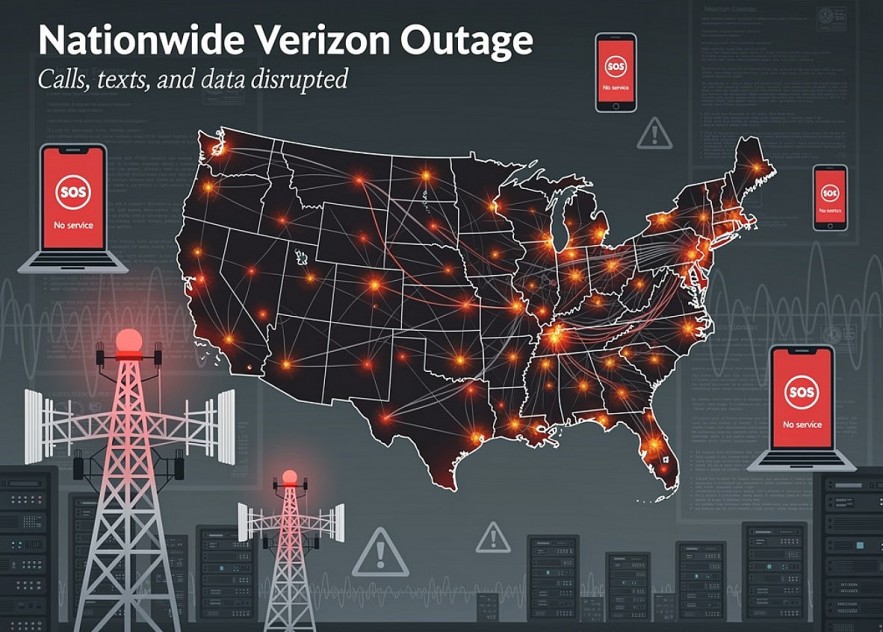
| Verizon outage map |
When Verizon’s wireless network failed across the U.S. on January 14, 2026, it wasn’t just a bad afternoon for customers. It was a stress test for a system that millions of Americans treat as basic infrastructure, the way they treat electricity and running water. And on Wednesday, that infrastructure buckled.
The outage knocked many phones into “SOS” mode, disrupting calls, texts, and mobile data for large numbers of users. Verizon acknowledged the problem and posted an update on X at 4:12 p.m. ET, saying its team was “on the ground actively working” to fix the issue and that getting customers reconnected was its “top priority.”
But the public consequences went beyond inconvenience, because emergency communications entered the picture.
Read more:
- Top 3 Biggest Wireless Carriers in the U.S. Toda
- Who Pays When Verizon Goes Down?
- Verizon Outage Update: Service Largely Restored
 |
| When Verizon Went Down, Public Safety Was Put at Risk |
911 warnings in major cities put public safety front and center
As the outage spread, New York City and Washington, D.C. pushed urgent alerts warning residents that the disruption may affect some users trying to call 911. Both cities urged people to try a device on another carrier, use a landline, or go directly to a police or fire station to report emergencies.
That is not a normal sentence for a major U.S. city to publish in 2026. It also undercuts the comforting assumption many people carry: Even if my carrier goes down, I can always reach 911.
The reality is more complicated. Phones in “SOS” mode may still be able to place emergency calls under some circumstances, but this outage triggered reports and official warnings that emergency connectivity could be unreliable in certain situations.
The FCC signals scrutiny: “take appropriate action”
The outage also triggered a fast regulatory response. FCC Chair Brendan Carr told Reuters after a congressional hearing that the agency would review the disruption and “take appropriate action.”
That matters, because the FCC’s involvement reframes this from “a company had a bad day” to “a carrier operating critical national communications infrastructure may have failed the public.” Investigations can focus on reliability, outage reporting, emergency access, and whether a carrier’s practices meet expectations for resilience.
Read more: Verizon Outage: Can You Still Call 911 in SOS Mode? What to Do If Calls Fail
Verizon’s biggest problem wasn’t only the outage — it was what came with it
Verizon’s public messaging Wednesday followed a familiar playbook: confirm an issue, say engineers are working, apologize, and avoid specifics.
Customers, however, are likely to want answers that go deeper than “we’re on it,” especially when the outage is national in scope and emergency calling is implicated. Three accountability questions stand out:
1) How can a single failure cascade nationwide?
Telecom networks are engineered with redundancy, but nationwide outages suggest a problem in shared systems: core network functions, authentication, routing, software updates, or centralized operations. Verizon has not publicly explained what failed.
2) Why were customers and cities left to fill the information vacuum?
When official details are thin, the public turns to crowdsourced trackers and rumor. During an outage that may affect 911 access, the cost of confusion is real. Even some national outlets noted Verizon offered no clear timeline for resolution for hours.
3) What protections exist for emergency communications when the primary network is down?
The fact that NYC and D.C. urged residents to use another carrier or a landline highlights a key vulnerability: lots of households no longer have landlines, and many don’t have a backup carrier device.
Read more: Widespread Verizon Outage: What is SOS on my Phone? And What I Can Do?
 |
| Is there a Verizon outage? What is SOS on my phone? Outage map, update |
The human cost: not just dropped calls, but broken routines and real risk
In a nationwide outage, the harm isn’t measured only in “couldn’t scroll” complaints. The damage includes:
-
People unable to reach family members, caregivers, or employers.
-
Missed medical calls, pharmacy coordination, ride pickups, and safety check-ins.
-
Small businesses losing payment processing or customer communications.
-
And, most seriously, uncertainty about emergency access.
Wired reported the outage affected U.S. mobile service and included impacts to some 911 calls, underscoring why local alerts treated this as a public safety issue, not just a customer service moment.
If Verizon wants trust back, here’s what customers will reasonably expect next
Verizon can’t undo the outage. But it can choose what happens after it.
A credible post-incident explanation.
Not a vague “technical issue,” but a plain-language account of what failed, what safeguards didn’t work as intended, and what is changing to prevent recurrence.
A timeline the public can understand.
When did the outage start, when did it peak, and what milestones marked restoration? The Verge noted the outage reports peaked around midday and remained significant for hours.
A clear emergency-communications review.
Did emergency calling degrade in certain areas? If so, why? What coordination occurred with public safety agencies? What will be improved?
Customer remediation that feels real.
People don’t want apologies; they want accountability. For some, that means bill credits or proactive outreach, especially if service remained unstable for hours.
Bottom line
Verizon’s January 14 outage should be treated as a national reliability event, not a social media blip. When the largest wireless carrier goes dark and cities warn residents about 911 connectivity, the bar for transparency and resilience rises immediately.
The FCC has now said it will review the outage and “take appropriate action.” The bigger question is whether Verizon will treat this as a one-day crisis to manage — or as a turning point to prove it can deliver the reliability the public assumes it already has.