How Many U.S. Troops Have Died in the Iran War? 13 Killed, 300 Wounded (Latest)



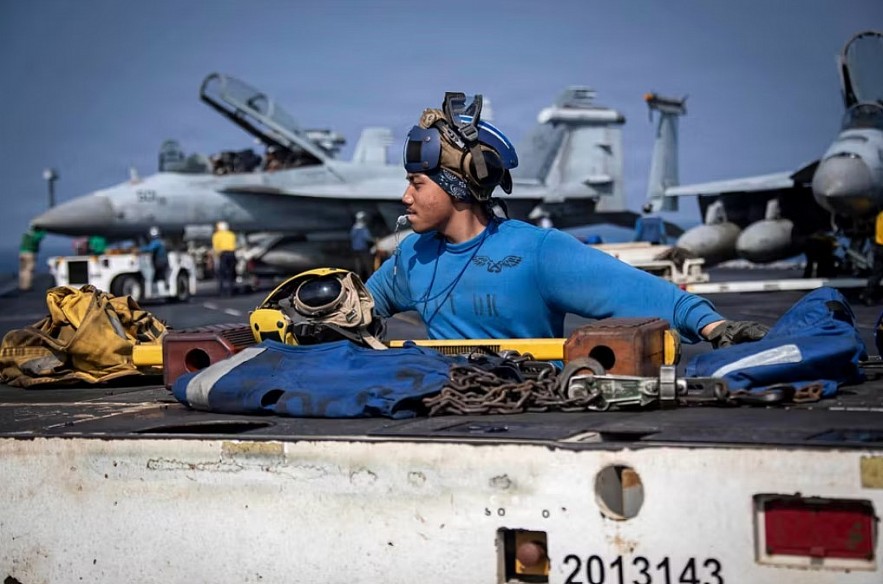 |
| A US Navy Aviation soldier operates a tractor on the flight deck of the aircraft carrier USS Abraham Lincoln, in the Arabian Sea |
13 U.S. service members have been killed and more than 300 wounded in the Iran war
As of March 30, 2026, the latest publicly reported U.S. military toll in the war with Iran in the Middle East stands at 13 American service members killed and more than 300 wounded. Reuters, citing a U.S. official on March 27, reported that 13 U.S. troops had been killed and more than 300 had been wounded since the conflict began on February 28, 2026. Reuters also said 273 of the wounded had already returned to duty by that point.
That broad casualty count was reinforced by the Associated Press, which reported on March 29 that more than 300 U.S. service members had been wounded, with 30 still unable to return to service and 10 considered seriously wounded. AP also said the latest Iranian attack on Prince Sultan Air Base in Saudi Arabia injured at least 15 U.S. troops, including five seriously, although earlier Reuters reporting on the same strike put the number at 12 wounded, including two seriously. The difference appears to reflect an evolving battlefield assessment as more information became available.
The deadliest single attack on U.S. personnel in the conflict’s opening phase came in Kuwait. U.S. Central Command said on March 2 that six U.S. service members had been killed in action after American forces recovered the remains of two previously unaccounted-for troops from a facility struck during Iran’s initial attacks.
The U.S. toll later rose again when Army Sgt. Benjamin N. Pennington, 26, of Glendale, Kentucky, died after being wounded in a March 1 attack on Prince Sultan Air Base in Saudi Arabia. AP reported that his death made him the seventh U.S. service member lost in the war at that stage.
A second major jump in fatalities came on March 12, when a U.S. KC-135 refueling aircraft crashed in western Iraq during Operation Epic Fury. Reuters reported that all six crew members were killed, and CENTCOM later confirmed that the loss was not due to hostile fire or friendly fire. That incident pushed the U.S. death toll from seven to 13.
So, the clearest verified breakdown of U.S. fatalities as of March 30 is this: six troops killed in the early Iranian strike in Kuwait, one soldier who later died of wounds after the Saudi base attack, and six airmen killed in the KC-135 crash in Iraq.
On the wounded side, the best current formulation is still “more than 300”, because that is the level confirmed by both Reuters and AP. What is clearer now is the condition of many of those wounded. Reuters reported that 273 had already returned to duty by March 27, while AP said 30 remained out of action and 10 were seriously wounded as of March 29. Those figures suggest that many injuries have been classified as minor to moderate, even as a smaller but significant group remains in serious condition.
The latest spike in injuries came during Iran’s strike on Prince Sultan Air Base. Reuters said 12 U.S. troops were wounded, while AP later reported at least 15 wounded, indicating the count may have risen after the first official briefings. Both outlets agree that the attack also damaged U.S. aircraft and underscored Iran’s continuing ability to hit American positions across the region even after weeks of U.S. strikes.
The numbers matter because they show that the conflict has become far more costly for U.S. forces than the first reports suggested in early March, when the public count stood at just three dead and five seriously wounded. By late March, the war had entered a very different phase: a sustained campaign with double-digit U.S. fatalities, hundreds of injuries, and continued risk to American troops deployed across Saudi Arabia, Kuwait, Iraq, and other regional bases.
U.S. Troop Death Toll in Iran Conflict Rises to Six as Wounded Climb to 18
As of the latest verified reporting, U.S. casualties in the ongoing conflict with Iran have increased since the initial announcement. U.S. Central Command now confirms that six American service members have been killed amid combat operations and Iranian retaliation across the Middle East, following initial reports of three deaths and five seriously wounded. In addition to the six fatalities, at least 18 U.S. troops have been reported wounded, with other personnel sustaining minor injuries such as shrapnel wounds and concussions as they are processed and returned to duty. These figures reflect the evolving toll of the intense hostilities after joint U.S.–Israeli strikes on Iranian targets and subsequent Iranian counterattacks on U.S. positions in the region.
The U.S. military has confirmed three American service members killed in action during the opening days of the escalating U.S. conflict with Iran, along with five troops described as “seriously wounded.” U.S. Central Command (CENTCOM) also said several additional personnel suffered minor injuries and were returned to duty, meaning the overall casualty count is higher than the “killed and seriously wounded” figures alone.
Those numbers, released on March 1, 2026, represent the first officially confirmed U.S. fatalities since the latest round of combat operations began. CENTCOM has withheld names pending family notification.
Read more: Who Will Lead Iran Next After Khamenei’s Death? The Key Contenders
Confirmed U.S. casualties so far
Based on the most recent official statements and major outlets reporting them:
-
Killed: 3 U.S. service members
-
Seriously wounded: 5
-
Additional wounded (minor injuries): “Several” (returned to duty; no precise number given publicly)
Because “several” has not been quantified, the best-supported approach is to report the confirmed totals while noting that the injury count extends beyond the five serious cases.
The bodies of the three American soldiers who were killed in an Iranian strike on a U.S. base in Kuwait have been transferred:
Where the casualties came from
The U.S. casualty announcement came amid reports of Iranian counterattacks on American positions in the Gulf. The Associated Press reported that Iran targeted U.S. bases in Bahrain and the United Arab Emirates, and it noted the U.S. military denied Iranian claims that ballistic missiles struck the aircraft carrier USS Abraham Lincoln, saying the missiles “didn’t even come close.”
This mix of base attacks, air defenses, and contested claims matters for readers tracking U.S. losses: even limited, unsuccessful strikes can still produce casualties if they hit facilities, interceptors, or nearby infrastructure.
Trump’s warning to Iran: “a force that has never been seen before”
President Donald Trump has paired the military campaign with direct deterrence messaging. In a March 1 post cited by Reuters, Trump warned Iran not to retaliate, writing that if it did, the U.S. would respond with “a force that has never been seen before.”
Trump also signaled that casualties, while politically sensitive, were not unexpected. The AP reported he acknowledged losses in war and suggested the conflict could continue for weeks, reflecting an administration posture that the operation is not a brief strike-and-exit event.
The wider escalation: strikes, counterstrikes, and maritime risk
Reuters reported Trump claimed U.S. forces had sunk nine Iranian naval vessels and were continuing attacks on Iran’s navy, while Iran launched hundreds of missiles and drones in response. That maritime dimension has global implications: even the perception of danger near key waterways can disrupt shipping, aviation routes, and energy markets.
Separately, Reuters also documented how tensions were building before the strikes. On February 19–20, 2026, Reuters reported Trump warned Iran it needed to make a nuclear deal within 10–15 days or “really bad things” would happen, as Washington increased its military posture in the region and Tehran warned it could hit U.S. bases if attacked.
What to watch next
If you’re tracking whether the U.S. death and injury totals will rise, the next indicators are practical:
-
Follow-on attacks on Gulf bases: Iran’s strikes on Bahrain and the UAE show U.S. installations are in play.
-
Carrier group exposure and air-defense tempo: Even when ships aren’t hit, missile and drone waves raise operational risk.
-
Duration signals from the White House: Trump’s public messaging suggests he expects a multi-week campaign, increasing the statistical likelihood of more casualties.
-
Clarity from CENTCOM: Further updates may specify the nature of the “minor injuries” and whether additional deaths occurred after March 1 reporting.
Bottom line
As of March 1, 2026, the confirmed U.S. toll in the Iran conflict stands at three killed and five seriously wounded, with several more sustaining minor injuries. Trump has warned Iran against retaliation, promising a response with “a force that has never been seen before,” while Iran’s counterattacks on Gulf bases and the maritime escalation keep the risk of further U.S. casualties high.