How Australians Can Find Cheap Flights: Smarter Travel in an Expensive Summer




Booking a flight in Australia in 2026 feels… unpredictable.
One moment, you stumble across a Sydney–Melbourne fare that looks like a bargain. A few hours later, it’s gone. Or worse, doubled. It’s not just you. The system itself has changed.
This year, airfare isn’t simply “expensive” or “cheap.” It’s uneven. Volatile. Sometimes frustratingly illogical.
And yet, if you understand how the market is behaving right now, you can still find genuinely good deals. Not mythical bargains. Real, workable value.
- Top 10 Best Websites to Book Cheap Flights in 2026
 |
| How To Find Cheap Flights in Australia |
A Market That’s Quietly Shifting Under Your Feet
The biggest change in Australia’s travel market isn’t just higher prices. It’s how those prices behave.
Airlines are facing rising fuel costs, and that pressure is already visible. Both Qantas and Virgin Australia have cut flights across key routes while raising fares in response to higher operating costs.
At the same time, something almost contradictory is happening:
airlines are launching massive sales to fill seats.
Virgin Australia recently released over 1.5 million discounted seats starting from around $55 one-way.
So which is it? Expensive or cheap?
The honest answer is: both.
Flights are no longer consistently priced. They’re strategically priced.
That’s the key insight for 2026.
Why Domestic Flights Feel So Expensive
If you’ve searched for domestic flights lately, you may have noticed something frustrating:
A short flight within Australia can cost as much as — or more than — a longer international trip.
This isn’t just perception. It’s structural.
Australia’s airline market is relatively concentrated, and on some routes, competition is limited. When demand is strong and capacity is reduced, airlines can raise prices — and often do.
Recent reports show a widening gap:
- Some domestic routes drop as low as $65
- Others spike dramatically, even reaching hundreds more depending on demand
That’s why the same country can feel both cheap and expensive at once.
- Don’t Skip Long Layovers: A Smart Way to Save on International Flights
- Cheap Flights Aren’t Gone - Americans Are Still Finding Them in 10 Tips
The New Rule: Don’t Chase Cheap - Recognize Value
Here’s where many travellers get stuck.
They wait.
They think: “Maybe it’ll drop tomorrow.”
Sometimes it does. Often, it doesn’t.
In 2026, the smarter approach is not chasing the lowest price. It’s recognizing a fair price when you see it.
If a flight:
- Fits your schedule
- Has reasonable baggage rules
- Doesn’t involve painful layovers
- And sits within your budget
…it may already be a good deal.
The 2026 Travel Rule
Stop asking: “Is this the cheapest?”
Start asking: “Is this good enough before it gets worse?”
That small mental shift can save you money—and stress.
Timing Still Matters… But Differently
Timing hasn’t disappeared. It’s just less predictable.
What still holds true:
- Midweek flights (Tue–Fri) are often cheaper
- School holidays and long weekends drive prices up
- Late-season travel can offer better value
But here’s what’s changed:
Airlines now adjust prices rapidly based on demand spikes. A fare can rise not because of the calendar, but because enough people clicked “search” at the same time.
Timing Insight: When You Actually Save
• Avoid peak holiday windows whenever possible
• Check flights ±2–3 days around your ideal dates
• Late summer or shoulder season often beats peak travel
• Book quickly when you see a solid fare
Why Flight Sales Matter More in Australia Than Anywhere Else
In the U.S., prices fluctuate constantly. In Australia, sales still matter.
Qantas and Virgin regularly release large batches of discounted seats — sometimes millions at a time.
These sales are where some of the best deals appear.
But they come with one catch:
they don’t last.
The best fares are often snapped up quickly, especially on popular routes like:
- Sydney → Melbourne
- Brisbane → Cairns
- Melbourne → Gold Coast
Deal Strategy: How Aussies Actually Win
• Subscribe to airline emails (yes, they matter)
• Check fares midweek when sales often drop
• Be ready to book within hours—not days
• Don’t expect the same deal to come back
- Which is The Cheapest Place to Fly to From Each State in the US?
Rethinking Destinations: The Quiet Shift in 2026
Something interesting is happening among Australian travellers this year.
They’re not cancelling trips.
They’re adjusting them.
Instead of long-haul Europe, many are choosing:
- Bali
- Fiji
- New Zealand
- Japan
- Southeast Asia
Not because they want to “downgrade” travel, but because they want better value.
Recent travel trends show Australians are becoming more strategic—prioritizing flexibility, cost efficiency, and overall experience rather than prestige destinations.
And honestly, that shift makes sense.
A Realistic Strategy Comparison
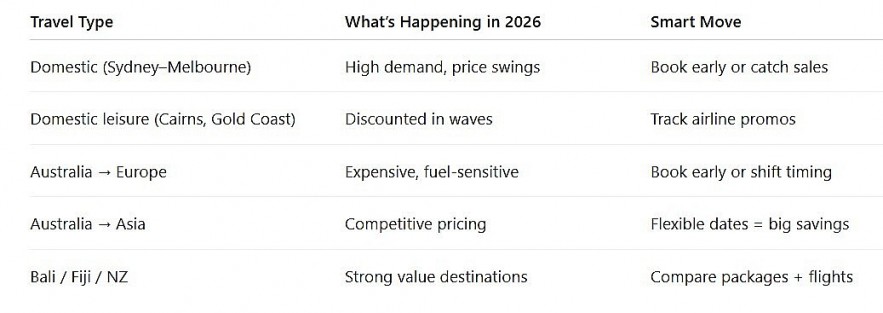 |
| Australia rewards flexible thinking more than almost any other market right now |
Travel Hasn’t Become Harder—Just Smarter
It’s easy to feel discouraged when flight prices don’t behave the way they used to.
But something else is happening beneath that frustration.
Travellers are becoming sharper. More intentional. Less reactive.
The Australians getting the best deals in 2026 aren’t the ones refreshing search pages all night.
They’re the ones who:
- Understand how pricing works
- Stay flexible without overthinking
- Recognize value when it appears
And perhaps most importantly, they don’t wait for perfection.
Because in a year like this, the perfect deal rarely shows up.
But the smart one often does.