How Many People Are in the World Today? The Truth Behind 8.3 Billion People
 Top 10 Largest Cities in the United States by Population (2026) Top 10 Largest Cities in the United States by Population (2026) |
 Top 10 States With the Most Homeless People in the U.S. in 2026 Top 10 States With the Most Homeless People in the U.S. in 2026 |
 How Many Jews Are There in the World Right Now? How Many Jews Are There in the World Right Now? |
 |
| How Many People Are In The World |
A Number That Keeps Growing Quietly
Pause for a moment and picture this.
Every second, somewhere in the world, a baby is born. At the same time, someone takes their final breath. These two quiet events, happening thousands of times every hour, shape the most important number humanity tracks:
As of April 2026, the world population is about 8.3 billion people.
It is such a large number that it almost loses meaning. Eight billion what? Eight billion lives, stories, ambitions, routines, and struggles. Numbers feel abstract, but the reality is intensely human.
And perhaps the most surprising part is this: the number is still rising, but not in the way it once did.
We Are Still Growing — But Something Has Changed
For decades, the story of population was simple: more people, faster growth, bigger pressure.
That story is no longer entirely true.
Today, the world adds roughly 190,000 people per day, or about 69 million per year. That sounds massive, but growth is slowing. In fact, global population growth has dropped to below 1% per year, a level not seen in generations.
There is a subtle shift happening beneath the surface. Families are getting smaller. People are living longer. Entire societies are aging.
The world is not just growing anymore. It is transforming.
Where Most of Humanity Lives
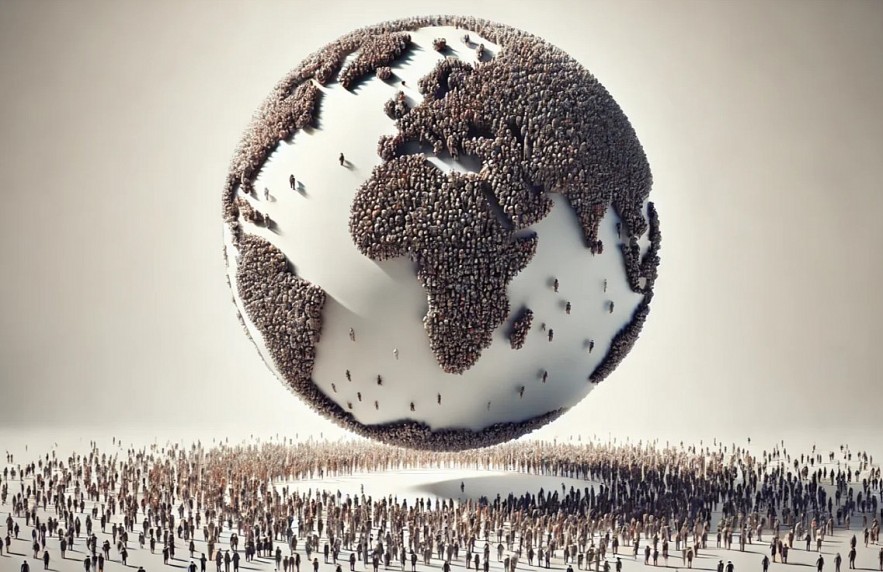
If you could look down at Earth from space and see people instead of lights, the distribution would surprise you.
Nearly 60% of the world’s population lives in Asia. Two countries alone, India and China, account for more than one-third of all humans alive today.
Meanwhile, Africa is quietly becoming the center of future population growth. By the end of this century, one in every three people on Earth may live in Africa.
The United States, often seen as dominant in global influence, holds only about 4% of the world’s population.
It is a reminder that population and power are not always the same thing.
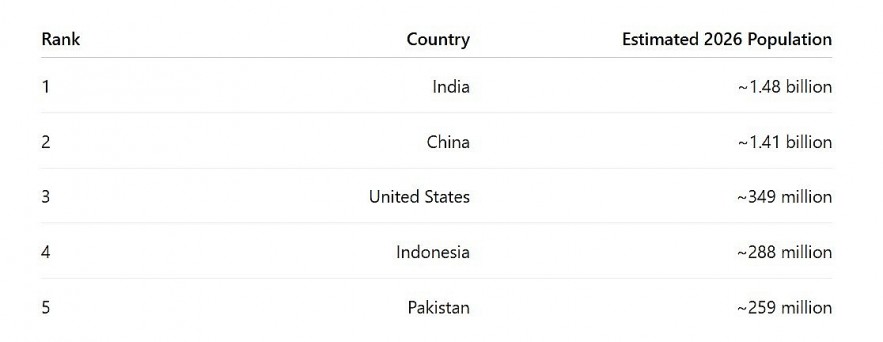 |
| The Top 5 Most Populous Countries in 2026 |
The Cities Are Taking Over
One of the most dramatic changes is not how many people exist, but where they live.
Just a century ago, most humans lived in rural areas. Today, more than half of humanity lives in cities. By 2050, that figure is expected to reach nearly 70%.
Mega-cities are becoming the new human habitat. Places like Tokyo, Delhi, and Shanghai are not just cities anymore. They are ecosystems of millions, functioning almost like living organisms.
And yet, with that growth comes tension: housing shortages, traffic, rising costs, and environmental strain.
Urban life promises opportunity, but it also quietly tests the limits of how we live together.
The World Is Getting Older
Here is a detail that rarely makes headlines but changes everything:
The world is aging.
In many developed countries, people are having fewer children than needed to replace the population. Japan, South Korea, much of Europe, and even China are seeing declining birth rates.
At the same time, people are living longer than ever before.
This creates a strange imbalance: fewer young workers, more elderly citizens, and increasing pressure on healthcare and social systems.
If the 20th century was about population explosion, the 21st century may be about population aging.
The “8 Billion” Milestone — And What It Really Means
When the world officially crossed 8 billion people in November 2022, it made headlines everywhere.
But milestones like this can be misleading.
It took humanity over 200,000 years to reach 1 billion people. Then only about 200 years to reach 8 billion.
The speed is what makes the number feel overwhelming.
And yet, despite that rapid growth, the future may look very different. Current projections suggest the world could peak at around 10.3 billion people in the 2080s, then slowly decline.
For the first time in modern history, we are beginning to imagine a world where population stops growing.
If Everyone Stood Together
Here is a perspective that makes the number feel real again.
If all 8.3 billion people stood shoulder to shoulder, they could fit within a relatively small area, roughly the size of a large city like Los Angeles.
It sounds impossible, but it is true.
The world does not feel crowded because of the number of people alone. It feels crowded because of how unevenly we are distributed, how we build cities, and how we consume resources.
The real challenge is not just population. It is organization.
So… Are There Too Many of Us?
This question lingers behind every population discussion.
Some argue that Earth is under pressure: climate change, food systems, water scarcity. Others believe human innovation will continue to solve these problems.
Personally, the more interesting question is not “How many people are too many?” but:
How do we live well together at this scale?
Because 8.3 billion is not just a number to manage. It is a reality to navigate.
Final Reflection
Right now, as you finish reading this, the number has already changed.
More people have been born. Others have passed away. The total has quietly shifted again.
That is what makes the global population so fascinating. It is never still. It is a living, breathing count of humanity itself.
Today, there are about 8.3 billion of us.
And for the first time, we are not just watching that number grow.
We are starting to wonder what happens when it stops.