6 Best AI Tools for Love Letters and Poems That Don’t Sound Artificial

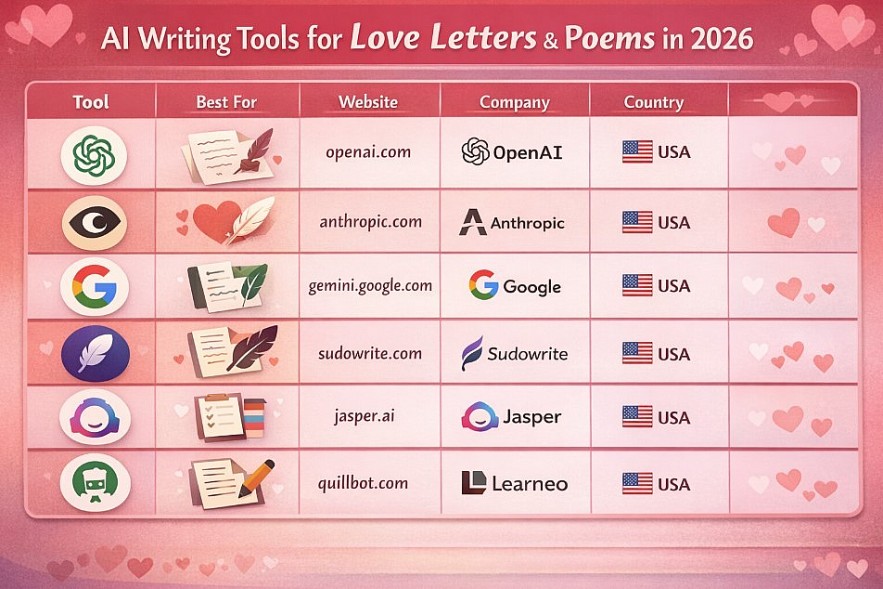 |
| Best AI Tool for Writing Personal Love Letters |
Writing a love letter is easy to get wrong. Too formal and it feels cold. Too poetic and it feels fake. Too short and it feels careless.
That tension is exactly why millions of people now use AI to help with Valentine’s Day writing. Not to replace emotion, but to shape it into language that works.
In 2026, the difference between a forgettable AI-written message and a meaningful one comes down to which tool you choose and how you use it. This article compares the most reliable AI tools for love letters and poems, with concrete reasons, ownership details, and trust considerations.
Read more: Valentine’s Day 2026: How AI Is Redefining Romance (Without Killing the “Real” Feeling)
1. ChatGPT
Website: https://www.openai.com
Company: OpenAI
Country: United States
Why ChatGPT works for love letters
ChatGPT is the most flexible option for Valentine writing in 2026. It handles structure extremely well, which matters more than people realize. A good love letter needs a clear opening, emotional development, and a satisfying close. ChatGPT does that reliably.
Best use cases
-
Long-form love letters (200–800 words)
-
Turning bullet-point memories into a coherent story
-
Rewriting awkward drafts into natural language
-
Adjusting tone precisely (calm, playful, shy, apologetic)
Trust and data considerations
OpenAI allows users to disable chat history and opt out of model training in settings. This makes ChatGPT a reasonable choice for personal writing, as long as users avoid sharing highly sensitive identifiers.
Why it’s credible:
ChatGPT is widely used across education, business, and creative writing, and benefits from constant iteration and feedback at massive scale.
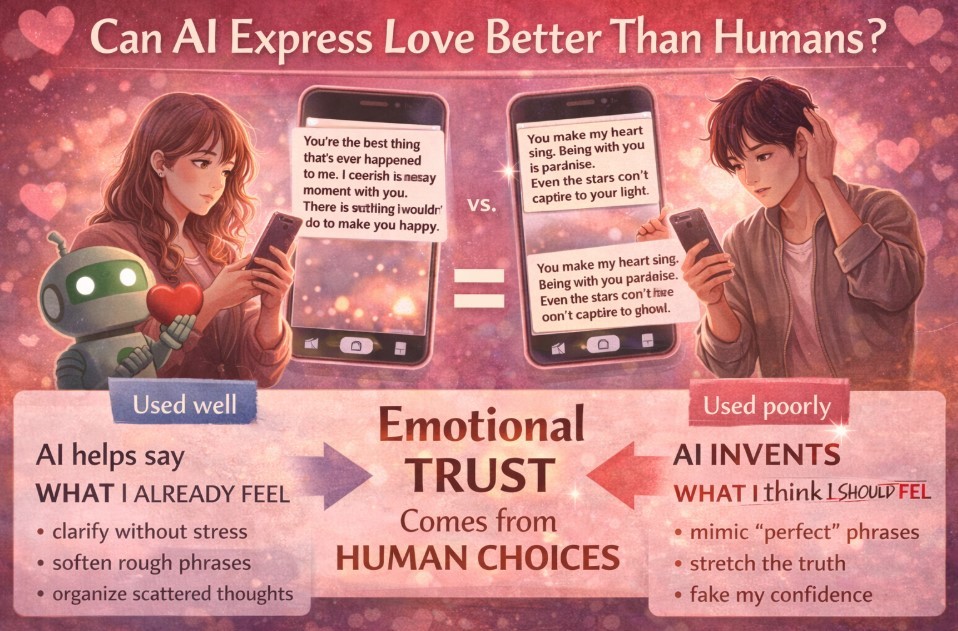
Read more: Can AI Express Love Better Than Humans? A Valentine’s Day 2026 Experiment
2. Claude
Website: https://www.anthropic.com
Company: Anthropic
Country: United States
Why Claude feels more “human”
Claude has become a favorite for emotional writing because of its sentence rhythm. It tends to avoid dramatic flourishes and instead produces softer, more conversational phrasing.
Many users describe Claude’s output as something they could imagine themselves actually saying.
Best use cases
-
Emotionally sensitive love letters
-
Messages that need restraint and maturity
-
Writing that avoids clichés by default
Trust and data considerations
Anthropic offers incognito-style options, but its policies have evolved. Users should actively check privacy settings before entering personal content.
Why it’s credible:
Anthropic positions Claude around safety, alignment, and responsible AI, which appeals to users who care about emotional nuance.
Read more: Top 5 AI Tools for Valentine’s Day 2026: Which One Fits Your Relationship Best?
3. Gemini
Website: https://gemini.google.com
Company: Google
Country: United States
Why Gemini fits everyday Valentine writing
Gemini’s biggest strength is context. If your drafts live in Google Docs, Gmail, or Android notes, Gemini integrates naturally into that workflow.
It’s especially useful for rewriting something you already wrote rather than generating romance from scratch.
Best use cases
-
Editing love letters in Google Docs
-
Writing short Valentine messages or emails
-
Refining tone and clarity
Trust and data considerations
Gemini operates under Google’s broader privacy framework. Users should be cautious when enabling cross-app personalization.
Why it’s credible:
Google’s long history in productivity software makes Gemini a practical, low-friction option for daily writing tasks.
 |
| Valentine’s Day 2026: How AI Is Redefining Romance With Love Letters, Poetry, Art, and Viral Short Videos |
4. Sudowrite
Website: https://www.sudowrite.com
Company: Sudowrite Inc.
Country: United States
Why Sudowrite is best for poems
Sudowrite is built for creative writers, not general productivity. Its poetry tools focus on imagery, line breaks, and emotional pacing rather than efficiency.
That makes it ideal for Valentine poems that don’t rhyme like greeting cards.
Best use cases
-
Free-verse poems
-
Short lyrical pieces for cards
-
Romantic writing focused on mood and imagery
Trust and data considerations
Sudowrite markets itself to writers and authors, and its value lies in collaboration rather than content harvesting.
Why it’s credible:
It’s widely used in fiction-writing communities and creative workshops.
5. Jasper
Website: https://www.jasper.ai
Company: Jasper AI
Country: United States
Why Jasper is useful (in specific cases)
Jasper is not romantic by default. Its strength is control. You can define a voice and apply it consistently across multiple outputs.
That makes Jasper relevant for:
-
Influencers
-
Brands running Valentine campaigns
-
People who want predictable structure
Best use cases
-
Multiple versions of Valentine messages
-
Consistent tone across letters, captions, and emails
Trust and data considerations
Jasper emphasizes enterprise-grade security and states that customer data is not used to train external models.
Why it’s credible:
It’s designed for professional environments with compliance requirements.
6. QuillBot
Website: https://www.quillbot.com
Company: Learneo
Country: United States
Why QuillBot matters for Valentine writing
QuillBot is not a generator. It’s a polisher. This is crucial for people who already know what they want to say but struggle with flow or grammar.
Best use cases
-
Cleaning up non-native English love letters
-
Short Valentine messages
-
Reducing repetition and stiffness
Trust and data considerations
QuillBot states that it does not allow third-party training on user inputs.
Why it’s credible:
It’s widely used in academic and professional contexts for rewriting clarity.
How to choose the right AI tool for Valentine’s Day• You want a heartfelt letter: ChatGPT or Claude • You want something gentle and understated: Claude • You already wrote the message: Gemini or QuillBot • You want a real poem: Sudowrite • You need multiple controlled versions: Jasper No tool works without your input. The most meaningful results always come from specific memories and honest intent. |
Final takeaway
AI did not make love letters easier by automating emotion. It made them easier by reducing friction.
In 2026, the best Valentine messages are not “written by AI.”
They are written with AI, guided by human memory, judgment, and care.