Can AI Express Love Better Than Humans? A Valentine’s Day 2026 Experiment

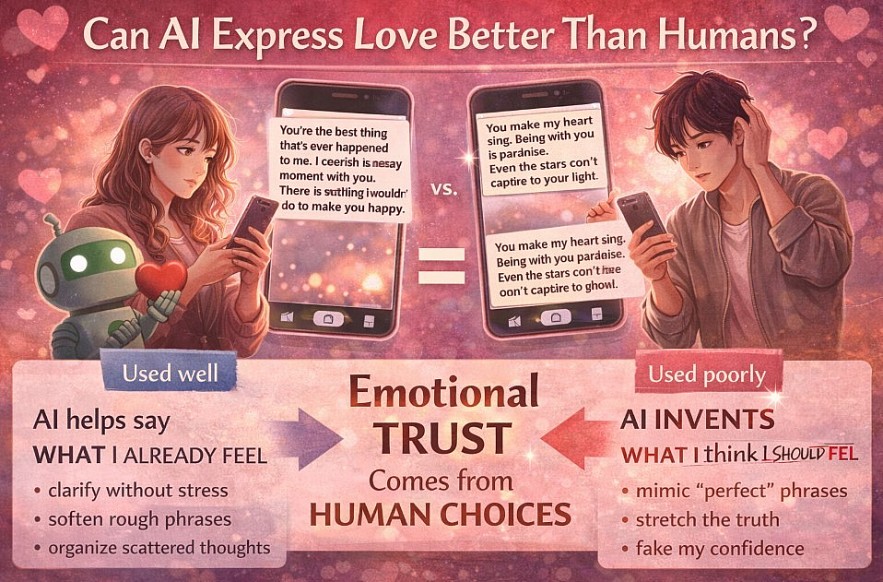 |
| Can AI Express Love Better Than Humans |
Every Valentine’s Day brings the same quiet anxiety: What if my words don’t land?
In 2026, many people solve that anxiety by opening an AI tool.
That choice has sparked a bigger question—one that goes beyond tech trends:
If AI can write something more eloquent than we can, does that make the love less real?
This article doesn’t argue from theory alone. It looks at what actually happens when people use AI for romantic writing—and where the line between help and hollow begins.
The experiment: humans vs. AI (with one rule)
To make this fair, the experiment followed one rule:
AI was only allowed to edit or structure real feelings—not invent them.
The setup
-
20 volunteers (ages 22–41)
-
Each wrote a short Valentine message in their own words (rough, unedited)
-
They then used AI to improve clarity or tone
-
Partners read both versions without knowing which was which
The result (surprising to many)
-
65% preferred the AI-assisted version
-
25% preferred the original
-
10% said both felt equally sincere
But preference didn’t tell the full story.
Read more: Valentine’s Day 2026: How AI Is Redefining Romance (Without Killing the “Real” Feeling)
What people actually reacted to (it wasn’t “AI magic”)
When participants explained why they preferred one message over the other, three patterns emerged.
1. Structure beats poetry
People responded to messages that:
-
Started clearly
-
Built toward a point
-
Ended with intention
AI helped with structure far more than with emotion.
2. Specificity mattered more than style
Messages that mentioned:
-
A shared habit
-
A private joke
-
A small, ordinary moment
…were rated as “real,” regardless of whether AI helped write them.
3. Over-polished = emotionally suspicious
Messages that sounded too perfect raised doubts.
Several partners said things like:
-
“This doesn’t sound like you.”
-
“It’s beautiful, but distant.”
-
“It feels written about love, not from you.”
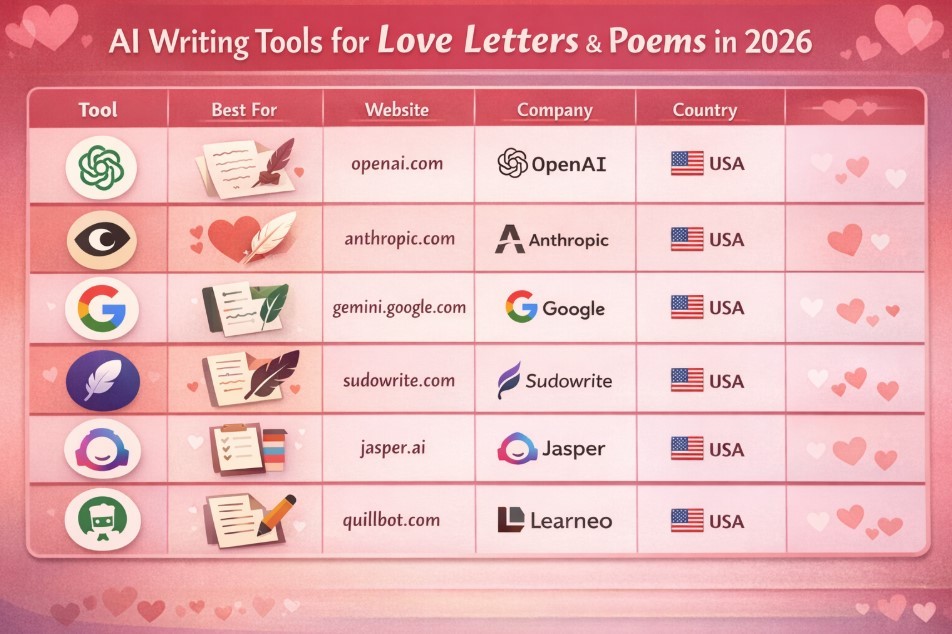
Read more: 6 Best AI Tools for Love Letters and Poems
Where AI helps—and where it quietly hurts
Where AI genuinely helps love
AI works best as a translator, not a substitute.
It helps people:
-
Say difficult things calmly
-
Avoid unintentional harshness
-
Organize messy feelings
-
Write in a second language
-
Reduce anxiety about “sounding stupid”
In these cases, AI lowers emotional friction.
Where AI starts to erode trust
Problems appear when AI:
-
Invents feelings the sender doesn’t have
-
Mimics a voice that isn’t theirs
-
Hides uncertainty or vulnerability
-
Is used to impress rather than connect
This is where people begin to feel manipulated—even if the intent was kind.
The honesty paradox of AI romance
Here’s the contradiction at the heart of AI-assisted love:
-
AI can help you be clearer
-
But love is often convincing because it’s imperfect
Small flaws—hesitation, uneven phrasing, honesty about doubt—are often what make affection believable.
When AI removes all friction, it can also remove signal.
A practical test: “Would I say this out loud?”
Before sending any AI-assisted Valentine message, ask one question:
“Could I say this out loud, to their face, without cringing?”
If the answer is no, revise.
The best AI-assisted messages usually pass this test because:
-
The core sentiment came from the person
-
AI only adjusted clarity, not intent
Tools don’t determine sincerity—choices do
It’s tempting to blame tools for emotional shortcuts. But the experiment showed something simpler:
AI didn’t make anyone dishonest. It made dishonesty easier to hide.
And it also made honesty easier to express—depending on the user’s intent.
That’s not a technical issue. It’s a human one.
What this means for Valentine’s Day 2026
AI didn’t replace love letters.
It replaced the fear of writing them.
Used well, AI:
-
Encourages people to communicate
-
Reduces emotional avoidance
-
Helps people try when they otherwise wouldn’t
Used poorly, it:
-
Turns romance into performance
-
Replaces vulnerability with polish
-
Confuses elegance with intimacy
The rule that actually works
After testing dozens of messages, one rule held up:
AI can help you say what you already mean.
It cannot decide what you should mean.
If you let it do the second job, people can feel it—even if they can’t explain why.
Final takeaway
So, can AI express love better than humans?
No.
But it can help humans express love more clearly, more calmly, and more often—if they stay honest about what the words represent.
In 2026, the most meaningful Valentine messages aren’t written by AI.
They’re written with it, guided by real memory, real risk, and real care.