Verizon vs. AT&T vs. T-Mobile: Which is Best in 2026?

 |
| Verizon vs. AT&T vs. T-Mobile (2026): The Deep Comparison Americans Actually Need |
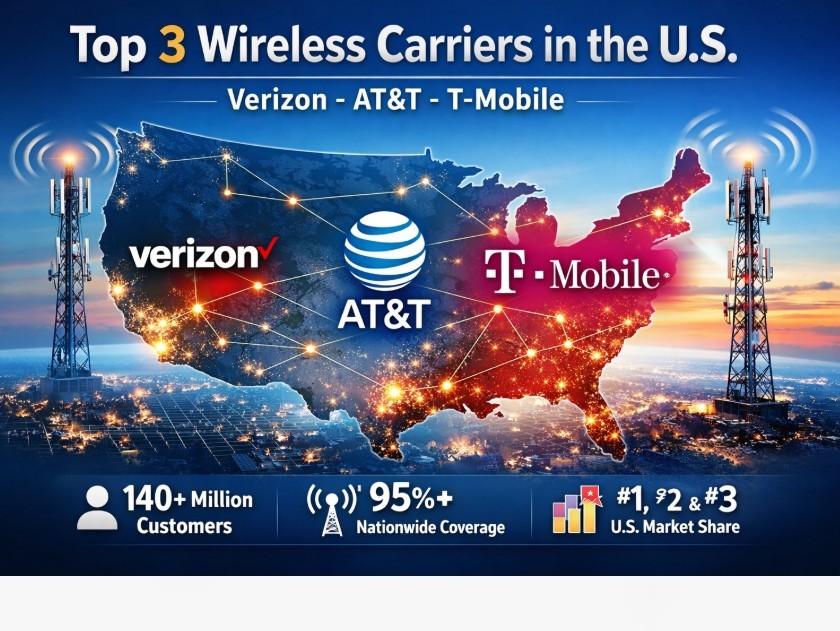
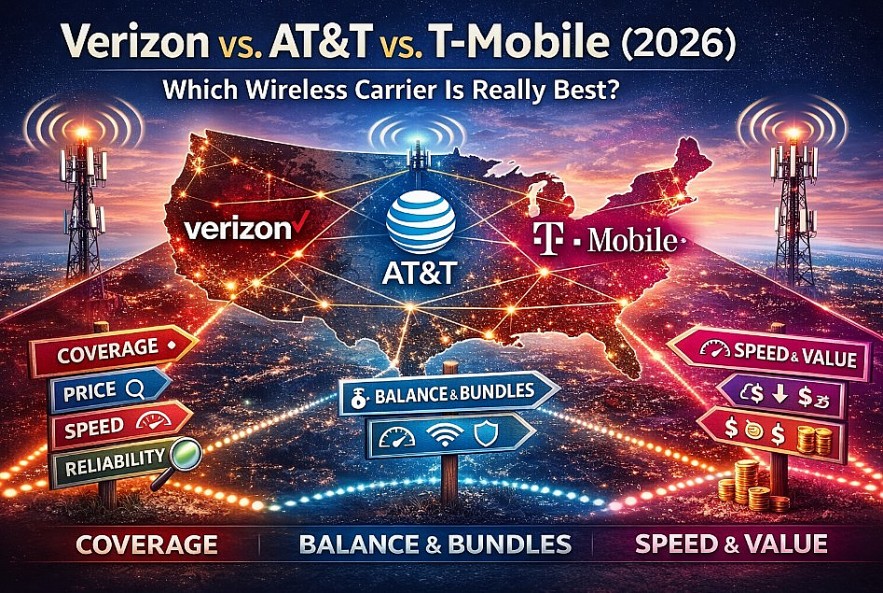
America has lots of wireless brands, but nearly all service rides on three nationwide networks: Verizon, AT&T, and T-Mobile. Their differences aren’t just marketing. They show up in coverage, speed, reliability, pricing philosophy, and how each carrier handles growth.
Below is an updated, data-backed comparison using carrier filings plus independent testing and market-share estimates.
Read more: Top 3 Biggest Wireless Carriers in the U.S. Today - Who Really Runs America’s Mobile Networks?
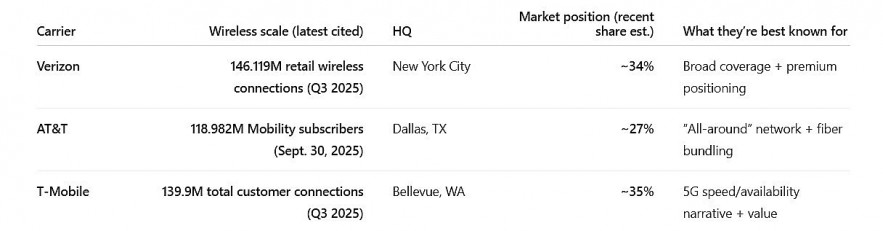
The scorecard at a glance
Sources: Verizon FOI (Q3 2025) ; AT&T 10-Q (Sept. 30, 2025) ; T-Mobile Q3 2025 earnings ; U.S. market share estimate (Dec. 31, 2024)
Note on “market share”: Different firms measure it differently (subs, connections, etc.). The Telegeography snapshot is a clean, widely cited baseline.
 |
| Verizon vs. AT&T vs. T-Mobile |
1) Coverage: who reaches the most places?
Verizon still carries the strongest brand association with nationwide coverage, especially in suburban/rural areas. But coverage is no longer a simple “Verizon wins” story everywhere, because:
-
T-Mobile has dramatically expanded post-Sprint, and often looks strongest on 5G footprint in national mapping comparisons.
-
AT&T frequently lands in the middle on coverage maps, while competing hard on reliability and consistency.
If your readers want a neutral way to compare coverage, the FCC National Broadband Map’s mobile provider detail is one of the least “marketing-driven” starting points.
Practical takeaway: Coverage is hyper-local. In 2026, the “best coverage” carrier can change from one neighborhood to the next—especially indoors.
2) Speed and 5G performance: who’s actually fastest?
Independent testing generally supports this broad pattern:
-
T-Mobile tends to lead on overall speed and 5G availability in many national summaries. For example, Ookla’s mid-2025 “connectivity” scoring placed T-Mobile first, followed by Verizon and AT&T.
-
Verizon often wins important 5G-specific categories in some test frameworks (the kind Verizon uses in advertising), even when it doesn’t win “overall speed.” Recent reporting summarizing Opensignal’s latest U.S. report notes Verizon taking specific wins such as Coverage Experience and 5G Video Experience.
-
AT&T can look less flashy on “fastest” headlines but scores well on steadiness and overall performance in some national testing.
Practical takeaway:
If your day is mostly video, hotspots, and heavy data in metro areas, T-Mobile’s speed edge is often meaningful. If you value “it just works” behavior in more places, Verizon/AT&T can still win depending on region.
3) Reliability: what the 2025–2026 data says (and what outages remind us)
There’s no single gold standard for “reliability,” so the best reporting compares multiple independent test firms:
RootMetrics: AT&T’s “overall” strength
RootMetrics testing for 2H 2024 put AT&T on top overall (including reliability, speed, and data performance), while noting Verizon and T-Mobile had edges in 5G-specific testing.
Opensignal (Jan. 2026): T-Mobile’s consistency lead
Opensignal’s January 2026 U.S. report (as summarized by multiple outlets) showed T-Mobile winning Reliability Experience and Consistent Quality for a second report in a row.
Additional summaries report T-Mobile taking 12 of 16 categories, with Verizon and AT&T still winning select awards.
The real-world reality check: big outages happen
Testing scores measure typical experience. Outages measure resilience under stress. On Jan. 14, 2026, Verizon’s nationwide disruption became a reminder that even “best network” brands can suffer large systemic failures.
Practical takeaway:
-
AT&T often tests as a strong “all-around” network.
-
T-Mobile often wins on “consistency + speed” narratives.
-
Verizon still competes hard on coverage and premium positioning—but outages can damage that trust quickly.
4) Pricing philosophy: why the carriers feel so different
-
T-Mobile: typically the most aggressive on value framing (simpler plans, bigger bundles, promotions). Consumer guides frequently rank it best overall on value + performance tradeoffs.
-
Verizon: more “premium” positioning, often with add-ons and tiers that can raise the bill.
-
AT&T: leans into bundling (wireless + fiber) and has used bundles to drive subscriber adds.
If you’re writing for U.S. readers, this is the simplest truth: the cheapest plan is rarely the cheapest bill once fees, device promos, and add-ons kick in.
5) Home internet and “convergence”: why AT&T keeps talking about fiber
AT&T’s strategy is increasingly about “converged customers” (households that take both fiber and wireless). Reuters has reported AT&T leaning on bundles to drive wireless growth and reduce churn.
Meanwhile Verizon and T-Mobile are also pushing fixed wireless, but AT&T’s differentiator is how large its fiber build has become.
6) The “smaller carriers” question: are MVNOs real alternatives?
Yes and no.
Brands like Visible, Mint, Cricket, Boost, Xfinity Mobile, etc. can be cheaper—but most are MVNOs, meaning they rent network access from Verizon, AT&T, or T-Mobile. That means:
-
MVNOs can’t magically “work” if their host network is down.
-
Performance can be excellent, but prioritization and congestion handling may differ by plan.
If your article is connected to outage coverage, that point is huge: more brands doesn’t mean more independent networks.
So… which is best in 2026?
A sharp way to frame it for American readers:
-
Choose Verizon if you care most about broad reach and you’re willing to pay for a premium brand—especially outside major metros. (But keep a backup plan for rare big outages.)
-
Choose AT&T if you want a strong “balanced” network and you can benefit from fiber + wireless bundling.
-
Choose T-Mobile if you want the strongest blend of speed, 5G momentum, and value positioning, and your life is mostly metro/suburban.
The most honest advice: Check coverage and performance where you live and work, not just national awards. The FCC coverage view and independent test summaries are the fastest way to do that.
Best Carrier for… A Practical U.S. Wireless Matrix (2026)
| Use case | Best choice | Why it fits | What to watch out for |
|---|---|---|---|
| Rural users | Verizon | Historically strongest rural and highway coverage; fewer dead zones outside cities | Higher prices; outages still possible |
| Frequent travelers (U.S.) | Verizon | Consistent coverage across states; reliable interstate connectivity | Premium cost |
| Families & multi-line plans | AT&T | Strong family bundles, multi-line discounts, fiber + wireless savings | Coverage varies by region |
| Business & enterprise users | AT&T | Deep enterprise backbone, fiber integration, stable performance | Less aggressive pricing |
| Urban & metro residents | T-Mobile | Excellent 5G speeds, strong mid-band coverage in cities | Indoor/rural performance can vary |
| Heavy data users | T-Mobile | High-capacity 5G network, generous data policies | Congestion in some dense areas |
| Budget-conscious users | T-Mobile or its MVNOs | Lower monthly costs, taxes often included, frequent promos | Customer support, prioritization |
| Prepaid / no-contract plans | Mint Mobile / Visible | Much cheaper, flexible plans | Dependent on host network |
| Maximum reliability mindset | AT&T (slight edge) | Often tests well in overall reliability metrics | Slower on “fastest network” headlines |
| Value + performance balance | T-Mobile | Strong mix of speed, price, and availability | Coverage still uneven in remote areas |
Editor Note:
-
There is no universal “best” carrier. The best choice depends on where you live, work, and travel.
-
Awards ≠ your experience. National tests average thousands of locations; your neighborhood may behave differently.
-
MVNOs save money, not infrastructure risk. If Verizon/AT&T/T-Mobile goes down, their MVNOs usually go down too.
-
Outages change the equation. Recent nationwide disruptions have reminded users that even top-rated networks are not immune.