Three AI-Resistant Job: Salaries, Job Growth, and Where to Study in the US

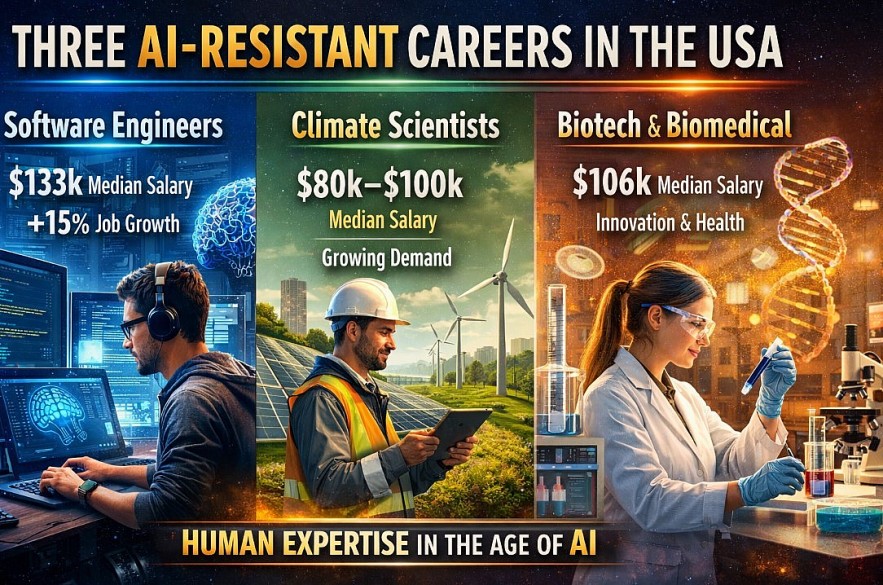 |
| Three Careers in the U.S. That Remain Resilient in the Age of AI |
As artificial intelligence reshapes the labor market, many professionals are asking a simple question: which careers will remain resilient?
According to insights shared by Bill Gates, three broad fields are likely to remain deeply human-driven for decades: software development, climate and energy science, and biological sciences/biotechnology.
Below is a detailed look at how these professions currently stand in the United States, including salary levels, job growth projections, and recommended education paths.
Read more: 6 Best AI Tools for Love Letters and Poems That Don’t Sound Artificial
1. Software Developers and Software Engineers
Current Salary in the U.S.
According to the U.S. Bureau of Labor Statistics (BLS):
-
Median annual salary: ~$133,000
-
Entry-level roles may start around $80,000
-
Senior engineers at major firms can exceed $200,000
This places software development well above the national median income across all occupations.
Job Growth Outlook (2024–2034)
-
Projected growth: ~15%, significantly faster than the average U.S. occupation
-
Tens of thousands of openings annually due to expansion and workforce turnover
AI tools are accelerating coding workflows, but they also increase demand for professionals who can design systems, manage complexity, and ensure security and scalability.
Education Path
Most employers require:
-
Bachelor’s degree in Computer Science, Software Engineering, or related field
-
Internships or project portfolios are highly valuable
-
Master’s degrees are common in AI, cybersecurity, or systems engineering roles
Top U.S. Universities
Highly ranked institutions for computer science include:
-
Massachusetts Institute of Technology
-
Stanford University
-
Carnegie Mellon University
-
University of California, Berkeley
Graduates from these programs often enter high-growth tech sectors including AI, cloud computing, fintech, and cybersecurity.
2. Climate Scientists and Environmental Specialists
As climate change accelerates, the U.S. continues investing in environmental research, renewable energy, and sustainability initiatives.
Current Salary in the U.S.
-
Environmental Scientists (median): ~$80,000 annually
-
Atmospheric and climate scientists: often $95,000–$100,000+
-
Senior researchers and federal agency roles can exceed $110,000
Job Growth Outlook (2024–2034)
-
Projected growth: ~4–8% depending on specialization
-
Demand driven by climate policy, environmental regulation, renewable infrastructure, and risk modeling
AI assists with data modeling and prediction, but strategic decision-making, public policy integration, and large-scale environmental implementation remain human-centered.
Education Path
Typical requirements include:
-
Bachelor’s degree in Environmental Science, Atmospheric Science, Geoscience, or Meteorology
-
Many research or leadership roles require a Master’s or Ph.D.
-
Skills in data analysis, GIS, and climate modeling are increasingly important
Leading Universities
Top programs in climate and environmental sciences include:
-
Harvard University
-
Colorado State University
-
University of California, Davis
Graduates work in federal agencies, research institutions, energy companies, and international climate organizations.
3. Biologists, Biotech Professionals, and Biomedical Engineers
Advances in biotechnology, pharmaceuticals, genomics, and medical devices continue to drive employment in the life sciences sector.
Current Salary in the U.S.
-
Biomedical Engineers (median): ~$106,000 annually
-
Biochemists and biophysicists: often around $100,000+
-
Lab-based research roles may range from $60,000–$90,000 depending on seniority
Job Growth Outlook (2024–2034)
-
Projected growth: ~5–7%
-
Demand fueled by aging populations, personalized medicine, and biotech innovation
AI assists in drug discovery and data analysis, but experimental design, clinical research, and regulatory oversight require human expertise.
Education Path
Common academic routes include:
-
Bachelor’s degree in Biology, Biochemistry, or Biomedical Engineering
-
Advanced research careers typically require Master’s or Ph.D.
-
Lab experience and internships are essential for competitiveness
Leading Universities
Strong life-science programs are offered at:
-
Johns Hopkins University
-
University of California, San Diego
-
Massachusetts Institute of Technology
Many graduates move into pharmaceutical firms, biotech startups, medical device companies, and research hospitals.
Read more: Top 10+ Most Prestigious Schools for Biotechnology in The US Today
Key Takeaways
Across all three fields, a pattern emerges:
-
AI is transforming workflows, not eliminating these careers.
-
Salaries are well above national averages.
-
STEM education remains the primary entry path.
-
Advanced degrees significantly improve upward mobility.
-
Hybrid skills—combining domain expertise with data and AI literacy—offer the strongest long-term advantage.
While automation may replace repetitive tasks, careers that require systems thinking, scientific discovery, and strategic responsibility remain resilient in the American labor market.