Who Are the 4 Top Candidates for Federal Reserve Chair? Bios of Hassett, Waller, Warsh & Rieder

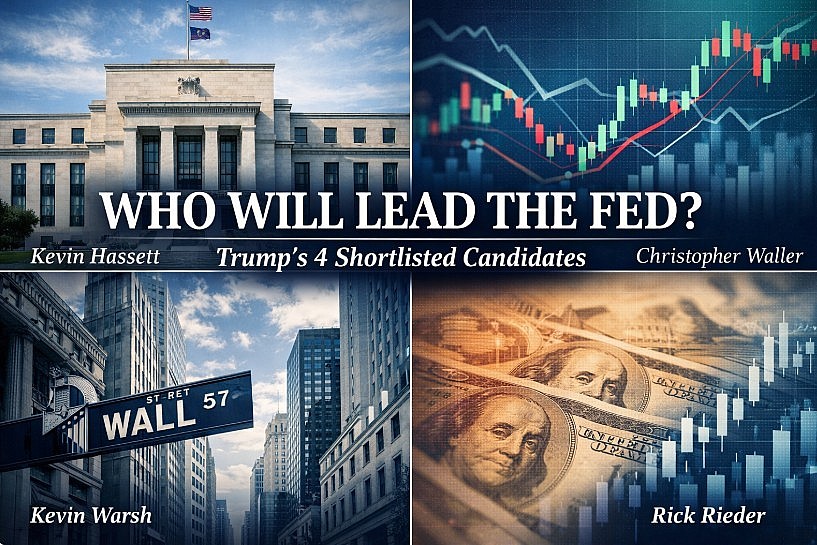 |
| Who Will Lead FED |
As President Donald Trump prepares to announce his nominee for Federal Reserve Chair — a decision that could reshape U.S. monetary policy — four leading candidates stand out: Kevin Hassett, Christopher Waller, Kevin Warsh, and Rick Rieder.
Each brings a distinct background, worldview and career path to the race to replace Jerome Powell when his term ends in May 2026. Trump’s shortlist reflects his preference for leaders who favor lower interest rates and strong economic growth, even amid debates over central bank independence.
Read more:
- Who will replace Federal Reserve Chair Jerome Powell? A look at the finalists
- Who is Jerome Powell? Biography, Family Life, Career, And Net Worth
1. Kevin Hassett – Trump’s Trusted Economic Adviser
Who he is:
Kevin Allen Hassett is an American economist best known for his role as a close adviser to President Trump. He currently serves as Director of the White House National Economic Council — a powerful role coordinating economic policy across the administration.
Background & Career:
Hassett grew up in Greenfield, Massachusetts, and excelled academically, earning a PhD in economics from the University of Pennsylvania after completing his bachelor’s degree at Swarthmore College. His career spans academia, government and think tanks. He served nearly a decade as an economist at the Federal Reserve Board of Governors in the 1990s and later became a resident scholar at the conservative American Enterprise Institute (AEI). In the Trump administration’s first term, he was Chairman of the Council of Economic Advisers (2017–2019) and later returned to the White House as NEC director in 2025.
Views & Influence:
Known for vigorously defending Trump’s economic agenda — including tax cuts and trade policy — Hassett aligns closely with Trump’s pressure for aggressive interest rate cuts. His close working relationship with the President makes him a familiar but politically charged contender for Fed chair.
Family & Personal Life:
Hassett keeps a relatively private personal life, with public profiles focusing on his professional work rather than family finances or personal details.
2. Christopher J. Waller – The Fed Governor Inside the System
Who he is:
Christopher J. Waller is an American economist and current member of the Federal Reserve Board of Governors, confirmed in 2020 and serving through 2030 unless reappointed.
Background & Career:
Born in Nebraska in 1959, Waller earned his BS from Bemidji State University and both his MA and PhD in economics from Washington State University. He spent decades in academia, teaching economics at institutions including Indiana University, University of Kentucky and the University of Notre Dame. In 2009, he joined the Federal Reserve Bank of St. Louis as executive vice president and research director — where he led work on the Fed’s renowned FRED economic data platform.
Federal Reserve Role & Views:
As a Fed governor, Waller has shifted from monetary “dove” to a voice supporting measured rate changes based on economic conditions. He has also emphasized the importance of central bank independence and evidence-based policy, making him a candidate with deep institutional credibility.
Family & Personal Life:
Waller’s public profile focuses on his career and academic contributions; personal and family details generally remain out of the spotlight.
3. Kevin Warsh – The Former Fed Governor and Wall Street Insider
Who he is:
Kevin Maxwell Warsh is a seasoned economist and former Governor of the Federal Reserve Board (2006–2011). At age 35, he was one of the youngest governors in Fed history.
Background & Career:
Warsh built his career on Wall Street with Morgan Stanley, rising to executive director in mergers and acquisitions before moving into government service as Special Assistant to the President for Economic Policy. His Fed tenure included a central role in managing the 2008 financial crisis and working closely with leaders such as Ben Bernanke. After leaving the Fed, Warsh became a distinguished fellow at Stanford’s Hoover Institution, advised major corporations, and served on boards including UPS.
Policy Views:
Warsh is known for advocating structural reform and a smaller Fed balance sheet. His experience straddles government and finance, but his views occasionally clash with Trump’s push for rapid, deep rate cuts.
Personal Life:
Beyond his professional accomplishments, Warsh’s personal and family life is kept private in public records.
4. Rick Rieder – Wall Street’s Bond King and BlackRock Executive
Who he is:
Rick Rieder is a veteran investment executive at BlackRock, serving as Chief Investment Officer of Global Fixed Income and leading teams tasked with managing trillions in bonds — roughly $2.4 trillion in assets.
Background & Career:
Rieder graduated from Emory University and earned an MBA from The Wharton School at the University of Pennsylvania. His career began at SunTrust Banks, followed by two decades at Lehman Brothers, where he rose through credit and trading ranks. After founding R3 Capital Partners, he joined BlackRock in 2009, becoming a key figure on the firm’s Global Executive Committee and Investment Council. He also serves on advisory boards for Alphabet (Google) and UBS, and has participated in the Federal Reserve’s Investment Advisory Committee.
Views & Wealth:
Rieder advocates for rate policies that consider labor markets and housing affordability while cautioning against outdated inflation measures. Although precise net worth figures aren’t publicly disclosed, his compensation and leadership roles at BlackRock position him among the most influential bond market professionals globally.
Family & Personal Life:
Rieder is married with children, though he keeps those personal details private. He also engages in philanthropy, supporting education and community outreach programs.
Conclusion
With Trump expected to announce his Fed chair nominee imminently, the choice between Hassett, Waller, Warsh and Rieder will signal the future direction of U.S. monetary policy — from political alignment to market confidence and central bank independence. Each candidate offers unique strengths: Hassett’s political loyalty, Waller’s institutional depth, Warsh’s crisis era experience, and Rieder’s Wall Street insights. Their varied backgrounds make this nomination one of the most consequential in years.