What Is the SAVE America Act? The Bill Reshaping Registration, ID Rules, and Mail Ballots

 |
| How the SAVE America Act could affect voters? |
A Republican-backed voting proposal called the SAVE America Act is back at the center of the U.S. election debate heading into 2026. Supporters say it closes loopholes and restores trust by ensuring only U.S. citizens vote in federal elections. Critics argue it creates new barriers that could keep eligible Americans off the rolls, especially people who don’t have easy access to specific documents.
Below is what the bill does, what’s changed in newer versions, and why it’s so polarizing.
What the SAVE America Act is (and where it is in Congress)
The SAVE America Act is the name used in H.R. 7296 (119th Congress, introduced Jan. 30, 2026). It would amend the National Voter Registration Act of 1993 (NVRA) to require documentary proof of U.S. citizenship as a condition for registering to vote in federal elections.
As introduced, the bill is sponsored by Rep. Chip Roy (R-TX) and was referred to the House Administration Committee.
It’s closely related to the earlier SAVE Act proposals (often discussed as “Safeguard American Voter Eligibility” bills). A 2025 Congressional Research Service explainer describes the SAVE Act concept as requiring documentary proof of citizenship for federal voter registration and adding requirements connected to voter-roll maintenance.
What the bill would require: “documentary proof” of citizenship
The bill defines “documentary proof of U.S. citizenship” and lists acceptable documents. These include:
• A U.S. passport
• A REAL ID–compliant ID that indicates U.S. citizenship (note: not all REAL IDs show citizenship)
• Military ID + military record showing U.S. place of birth
• A government-issued photo ID showing U.S. place of birth
• A government photo ID paired with a qualifying citizenship document, such as a certified birth certificate, Consular Report of Birth Abroad, or naturalization/citizenship certificate, among others
A major practical shift: how mail registration would work
Under the bill, someone who uses the national mail voter registration form wouldn’t be registered unless they present proof of citizenship in person to election officials by the state deadline (or present it at the polling place in states that allow Election Day/early-voting registration).
The bill also sketches an alternative process for applicants who can’t provide the listed documents: states must create a process where the applicant can submit “other evidence” plus an attestation, with the Election Assistance Commission developing a uniform affidavit.
What’s “new” (or changing) compared with earlier versions
One reason this debate keeps reigniting is that the details have shifted across iterations.
The Brennan Center notes that when its analysis first ran, the SAVE America Act included a provision that would have required voters to show documents like passports or birth certificates at the polls every time they vote. It says the bill was later amended in the House to replace that with regular voter-roll submissions to the Department of Homeland Security (DHS) plus a restrictive photo ID requirement for voting.
News coverage of the 2026 push also describes the broader agenda around the proposal, including stricter voting ID rules and changes affecting mail ballots.
So when people argue about what the bill “does,” they may be reacting to different drafts: one version focused heavily on proof at registration; others layer in additional requirements tied to ID at voting, roll checks, and mail-ballot rules.
Why it’s controversial: the core disagreement
Supporters’ argument: “close the loopholes”
Backers say noncitizen voting is illegal already, but they believe the system still needs stronger verification. They frame the bill as a clear, national standard meant to increase election integrity and confidence.
Critics’ argument: “document demands = fewer eligible voters registered”
Opponents argue the bill solves a problem that isn’t occurring at scale, while adding friction for eligible voters. They emphasize practical access: many Americans don’t keep passports or paper birth certificates readily available, and replacing “click-to-register” with “show up in person with documents” can reduce registration and turnout.
A Brennan Center analysis cited in reporting estimates over 21 million Americans lack ready access to the kinds of documents typically required under these proposals.
Read more: Do Children Born in the U.S. Still Get Citizenship After the Supreme Court's Ruling?
Who could be affected (and why)
Here are the groups most frequently highlighted by election researchers and voting-rights advocates, with the specific “mechanism” that could affect them:
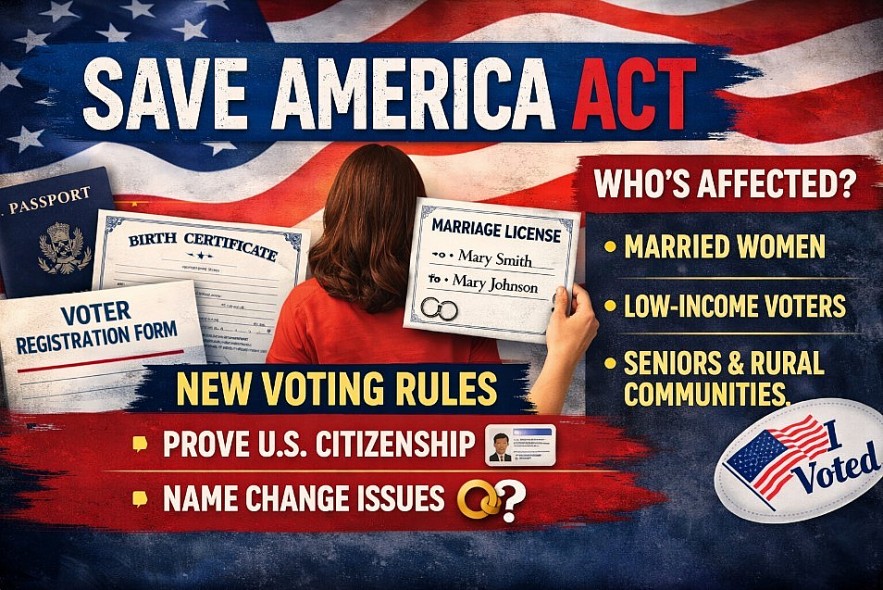
1) Married women and anyone who changed their name
If your proof of citizenship document (like a birth certificate) doesn’t match your current legal name, you may need extra paperwork and extra steps. Analysts note that millions of women with married names not reflected on birth certificates or passports could face additional hurdles to register.
2) Low-income and working-class voters
If the process requires taking time off work, traveling to an election office, paying fees for replacement documents, or navigating bureaucracy, the burden hits harder. Critics argue these “hidden costs” can function like a barrier even when the right to vote is technically intact.
3) Young voters and first-time registrants
Young adults are more likely to move often (dorms, rentals, job changes) and update registrations. The Campaign Legal Center warns that under these bills, even updates (like address or party changes) could trigger new documentation requirements.
4) Naturalized citizens
Naturalized citizens are eligible voters, but they may rely on naturalization documents that are easier to lose and harder to replace quickly than a driver’s license. The bill lists naturalization and citizenship certificates as acceptable proof, but critics worry about real-world friction and administrative errors.
5) Rural voters, older voters, and people with disabilities
If a state’s process effectively requires in-person document presentation for some common registration methods, distance, transportation, mobility limits, and local office hours matter a lot. The bill includes a requirement for “reasonable accommodations” for disabilities in presenting proof for mail registration, but what that looks like in practice could vary widely by state.
Read more: What Did the Supreme Court Decide on Trump’s Birthright Citizenship Order?
What changes could look like on the ground
If enacted and implemented aggressively, the practical impact would likely show up in three places:
•Registration pipelines: Online and mail registration could shrink if applicants must later show up in person with documents.
Administrative load: Local election offices could see more foot traffic and document processing, with more chances for delays, backlogs, or mistaken rejections.
Voter-roll maintenance fights: Provisions tied to roll checks and removals are politically explosive because voter-roll “purges” have a history of errors that remove eligible voters.
Where the debate is headed in 2026
Politically, the bill fits into a larger push to “nationalize” election rules that are traditionally state-run. Coverage suggests it may advance in the House but face steep resistance in the Senate.