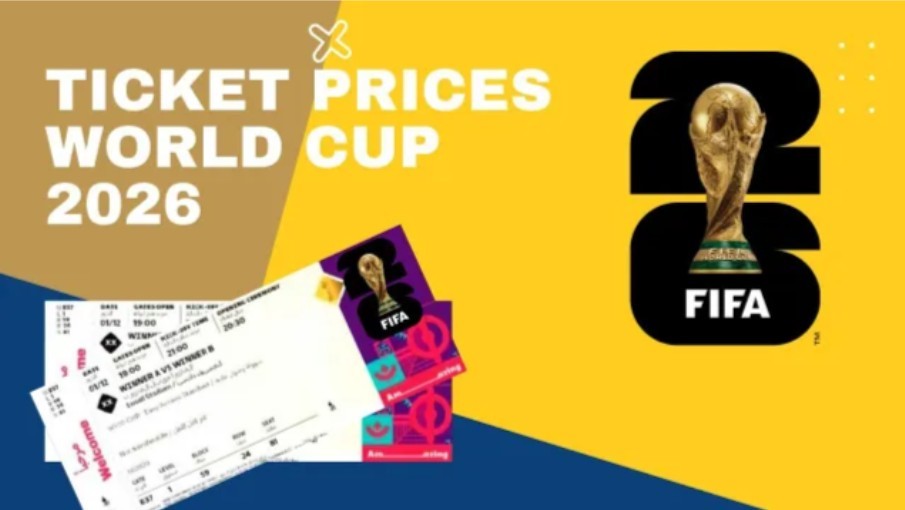
Ticket Prices for World Cup 2026: What Fans Should Expect

 How the 48-Team Format Will Change World Cup Upsets Forever How the 48-Team Format Will Change World Cup Upsets Forever |
 How Many Asian Teams Qualified for the 2026 World Cup? Full AFC List How Many Asian Teams Qualified for the 2026 World Cup? Full AFC List |
 Why Smaller Nations Could Be the Biggest Winners of World Cup 2026 Why Smaller Nations Could Be the Biggest Winners of World Cup 2026 |
 |
| World Cup 2026 Ticket Prices |
By now, “ticket pricing predictions” for the 2026 World Cup are not really predictions in the old sense.
The market has already started to show its hand.
FIFA’s ticket rollout, the first use of dynamic pricing at a men’s World Cup, and the early resale activity have given fans something much more useful than guesswork: a real pricing pattern. And that pattern says one thing clearly. World Cup 2026will be expensive at the top end, volatile in the middle, and only selectively affordable at the bottom.
That does not mean every fan is priced out. It does mean casual assumptions from past tournaments no longer work. A supporter planning for North America in 2026 should expect a tournament where the cheapest seats exist, but are scarce, while the most desirable matches can move sharply higher as demand spikes. Reuters reported that FIFA is using dynamic pricing for the first time at this World Cup, meaning the price for the same match and seating category can rise or fall depending on demand and inventory.
For fans, the smart question is no longer, “How much are World Cup tickets?” It is, “Which World Cup ticket market am I actually shopping in?”
Because there are really several of them at once.
The base line is now clear: group-stage tickets are broad, but not cheap
If you want a realistic starting point, begin with standard group-stage pricing rather than the headline-grabbing final.
Reuters reported in March that, outside the opening match, group-stage face-value tickets were generally running between $100 and $575, while the Mexico City opener was in a different tier altogether, ranging from $560 to $2,735.
That broad range matters.
It tells fans two things. First, the average “ordinary” group game is not necessarily priced like a luxury event. Second, once you add host nations, major football brands, marquee cities, or limited inventory, the numbers jump quickly.
AP’s December price breakdown showed exactly how sharply that spread can widen. Some lower-profile group games were listed at $450 or $500 for Category 1, with Category 3 seats down at $140 to $180. But matches involving hosts or global heavyweights were much higher. The United States’ opener in Inglewood was listed at $2,735, $1,940, and $1,120 across Categories 1 to 3, while Mexico’s opening match in Mexico City was listed at $2,355, $1,705, and $1,020.
So the first useful prediction is no longer really a prediction at all: fans should expect a split market in the group stage. There will be one price band for standard fixtures and another for anything tied to host-team demand, opening-night symbolism, or superstar appeal.
Why does the World Cup happen every 4 years?
The cheapest tickets are real, but they are not the norm
One of the biggest points of confusion around World Cup 2026 is the existence of the $60 Supporter Entry Tier.
Yes, it is real. FIFA announced that Supporter Entry Tier tickets would be priced at $60 and available across all 104 matches. But there is an important catch. Reuters reported that these tickets are very limited, tucked high in the stadium, and largely tied to Participating Member Association allocations for supporters of qualified teams. FIFA’s ticketing FAQ also says Supporter Entry Tier tickets are allocated specifically to supporters of qualified teams, with the selection and distribution handled by each national association.
That makes them important, but not representative.
In other words, the $60 figure is best understood as a floor, not a normal fan expectation. It is not the number most general-public buyers should build their entire budget around. A better working assumption is that the true entry point for open-market buyers will often be materially higher, especially once the most attractive fixtures thin out. Reuters also noted that, unlike Qatar 2022, where local residents could buy Category 4 tickets for as little as $11, no equivalent mass-market cheap tier has shaped the public pricing story in 2026.
Knockout prices rise in a fairly predictable curve, until the final breaks the model
The broad shape of the tournament pricing ladder is already visible.
Reuters reported that Round of 16 tickets ranged from $220 to $890, quarterfinals from $410 to $1,690, and semifinals from $455 to $2,780 at face value in early 2026. That suggests a pricing curve that is steep but still recognizable: every round costs more, but the increases are mostly proportional until the final.
AP’s posted price list from December reinforced that structure. It showed Round of 32 tickets commonly in the low hundreds, Round of 16 prices moving into the mid-hundreds, quarterfinals pushing past $1,000 in better categories, and semifinals leaping to more than $3,000 for Category 1 in some cases. The final, though, was already on another level, listed then at $8,680, $5,575, and $4,185 across Categories 1 to 3.
Then April happened.
AP reported on April 2 that FIFA reopened sales in a glitch-hit phase and raised the top price for the final again, to $10,990, with Category 2 at $7,380 and Category 3 at $5,785. The Guardian reported the same jump and noted how dramatic the increase was compared with Qatar 2022, where the top official price for the final had been $1,600.
That is the strongest pricing signal of the tournament so far. It suggests the final is not merely expensive. It is being treated as a premium event closer to the top end of U.S. mega-event pricing than to the historical norms of football ticketing.
Dynamic pricing means fans should stop thinking in fixed numbers
This is the real adjustment many supporters still have not made.
In older tournaments, a ticket price was more static. In 2026, that logic is weaker. Reuters explained that FIFA’s dynamic pricing system allows the same match and category to move up or down based on demand, speed of sales, and remaining inventory.
That changes how fans should read every number they see.
A price published this week may not hold next week. A seat that feels expensive early can look cheap later if demand surges. A neutral group match in a less glamorous slot may remain relatively manageable, while a host-nation fixture or a knockout in a major U.S. market can escalate fast. AP also reported that when sales reopened in April, FIFA had listed tickets for only 17 of the 72 group-stage matches, and no knockout tickets were then available in that release, with more inventory expected to be added gradually.
That makes one practical prediction easy: price volatility is now part of the World Cup experience. Fans should not expect one universal rate card. They should expect a moving market.
Resale could become the most painful part of the fan budget
Face value is only part of the story.
Reuters reported that FIFA is encouraging fans to use its official resale platform, where the organization charges a 15% fee on purchases and a 15% fee for reselling or exchanging tickets. Reuters also noted that residents of Mexico may list tickets for no more than the original purchase price, while that restriction does not apply in the United States or Canada.
That matters because North America changes the economics.
In previous World Cups, resale was more tightly controlled. In 2026, the legal environment in the U.S. and Canada makes a hotter resale market much more likely, especially for premium matches. Reuters explicitly noted that fans could list at higher prices on the resale platform, which opens the door to significant markups driven by scarcity and speculation.
We are already seeing the shape of that problem. AP reported criticism from lawmakers and fan groups over dynamic pricing and resale inflation, while other outlets have highlighted eye-watering resale listings for high-demand games. Even without relying on the most extreme examples, the direction is obvious: fans who wait too long for marquee games may end up paying not FIFA’s price, but the market’s price plus fees.
Hospitality sets the ceiling, and that ceiling is high
Official hospitality is a different market again, but it still matters because it helps define the upper end of what organizers believe buyers will pay.
On Location, FIFA’s official hospitality provider, is selling premium match and venue packages across the tournament. Its official venue pages show just how far the pricing ladder extends. For example, the Boston venue series was listed as starting at $11,150 per person, while the Mexico City venue series was listed at MXN 344,000 per person. On Location’s official pages also show single-match hospitality in major U.S. venues starting in the thousands rather than hundreds.
Most fans are not shopping in this category. But hospitality pricing still shapes expectations because it normalizes a premium-event mindset around the tournament. When that top end is strong, standard inventory below it can also hold firmer than supporters might hope.
What ordinary fans should realistically budget for
The most useful answer is not one number. It is a set of ranges.
For a lower-demand group game, a realistic expectation is now somewhere in the low hundreds at minimum, unless a buyer lands one of the limited cheaper options or a supporter allocation. For a mid-tier group game involving well-supported teams, the practical budget moves higher quickly, especially in better stadiums and better sections. For host-nation games, the evidence already points to an entirely different pricing lane, often hundreds or well over a thousand dollars depending on category.
For the knockouts, the message is simpler. The deeper the tournament goes, the less room there is for bargain hunting. By the quarterfinal stage, even face-value prices have already moved into premium territory. By the semifinals and final, the market is clearly aimed at buyers with substantial budgets or very high willingness to pay.
The smartest working budget is probably this: assume one neutral group game may still be attainable, but assume elite fixtures will cost far more than fans remember from older World Cups.
The real surprise may be the non-ticket costs around the ticket
One more warning is worth making.
The ticket itself may not be the whole financial shock. Reuters noted that demand for 2026 appears enormous, and that matters because this tournament stretches across three countries, 16 host cities, and long travel distances. That means airfare, hotels, local transport, and city-specific surcharges can turn a seemingly manageable ticket into a very expensive day or week.
That pressure is already visible in smaller ways. Reporting around host-city transport plans has shown how matchday travel costs can rise sharply in some markets. Even when the ticket price gets the headlines, the true cost of attending can be much higher once logistics are included.
For many fans, the most accurate pricing prediction for World Cup 2026 is not just “tickets will be expensive.” It is this: the tournament will reward early, disciplined planning and punish emotional late buying.
So, what should fans expect now?
They should expect a World Cup with three distinct truths.
First, there are still entry-level tickets in the system, including the $60 Supporter Entry Tier, but those options are limited and not the easiest path for general-public buyers.
Second, standard face-value pricing has already established a broad but serious range, from roughly $100-level group games to five-figure final tickets at the very top.
Third, dynamic pricing and resale mean the number you see today may not be the number you see tomorrow. In 2026, waiting is not neutral. It is a gamble.
That may frustrate traditional supporters. It may also define the commercial reality of this tournament.
Either way, fans should plan for a World Cup where the cheapest path still exists, but the easy path does not.
FAQ: World Cup 2026 Ticket Prices
What is the cheapest ticket for World Cup 2026?
The lowest officially announced price is around $60 for the Supporter Entry Tier. However, these tickets are very limited and typically allocated to fans of qualified teams through national associations.
For most general buyers, realistic entry-level prices for group-stage matches are likely to be significantly higher, often starting from around $100 or more depending on demand.
Why are World Cup 2026 tickets so expensive?
Several factors are driving higher prices for FIFA World Cup 2026:
- The tournament is hosted in North America, where sports events already command high ticket prices
- FIFA is using dynamic pricing, meaning prices increase with demand
- Strong global demand combined with limited supply for top matches
- Larger stadiums but also significantly higher operational costs
Together, these factors push prices higher than previous tournaments like 2022 in Qatar.
How much will World Cup 2026 final tickets cost?
Based on the latest available pricing updates, final match tickets can exceed $10,000 for top-tier seats.
Lower categories are cheaper but still expensive, often in the $4,000–$7,000 range at face value. Resale prices could be even higher depending on demand.
Will ticket prices go down closer to the tournament?
Not necessarily.
Because FIFA is using dynamic pricing, ticket prices can go up or down depending on demand. However, for high-demand matches such as:
- Opening games
- Host nation matches
- Knockout rounds
- The final
prices are more likely to increase over time, especially on resale markets.
Is it better to buy early or wait?
For most fans, buying early is the safer strategy.
Waiting may occasionally lead to lower prices for less popular matches, but for major games, delays usually mean:
- Higher prices
- Fewer seat options
- Greater reliance on resale platforms with added fees
Can fans resell World Cup 2026 tickets?
Yes, FIFA provides an official resale platform.
However:
- Buyers and sellers may pay fees (around 15%)
- Prices on resale can be higher than face value, especially in the U.S. and Canada
- Some restrictions may apply depending on the host country
Are hospitality packages worth it?
Hospitality packages are significantly more expensive but offer:
- Premium seating
- Food and beverage services
- Lounge access
- Guaranteed availability
They are generally aimed at corporate buyers or fans seeking a high-end experience rather than budget-conscious travelers.
Which matches are likely to be the most expensive?
The highest-priced matches typically include:
- The final
- Semi-finals and quarter-finals
- Opening matches
- Games involving major teams like Brazil, Argentina, France, or the host nations
These matches combine high demand, limited supply, and global attention.
How can fans get the best ticket deals?
To improve your chances of finding better prices:
- Register early on FIFA’s official ticket portal
- Be flexible with match selection and location
- Consider less popular group-stage games
- Avoid last-minute purchases for high-demand matches
- Monitor official resale platforms instead of third-party sites