The Smart Fan’s Setup: How to Watch Every NHL Game Without Overpaying

Trying to watch the NHL in the U.S. can feel simple at first—and then strangely complicated the moment you actually sit down to watch.
You subscribe to one service, thinking you’re covered. Then a game isn’t there. You add another, and now something else is missing or blacked out. Before long, you’re paying more than you expected and still not getting everything.
That’s the reality in 2026. NHL rights are split across national networks, regional channels, and streaming platforms. There isn’t a single “complete package.”
But there is a smarter way to get very close—without stacking subscriptions you don’t need.
This guide is built around how people actually watch hockey. Not perfectly. Not obsessively. Just in a way that works.
Read more: Hidden Tricks to Watch More NHL Games 2026 in the U.S
A realistic setup for most fans
Very few people need a full, all-inclusive system.
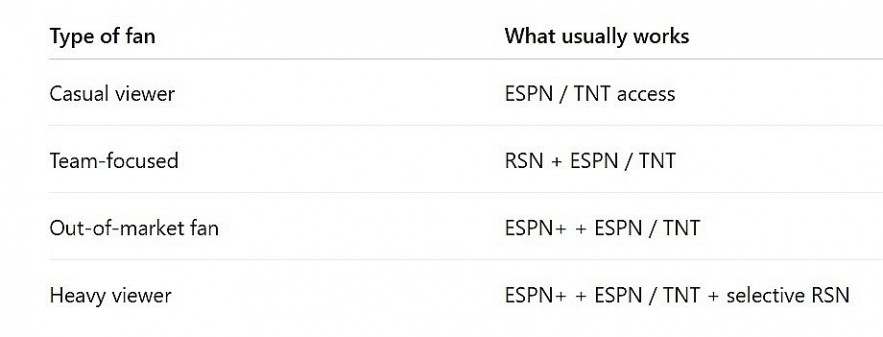
Most viewers fall into one of these patterns:
 |
| Setup for most fans |
The key is that each setup is built around a habit—not a goal of “having everything.
 |
| How to Watch Every NHL Game Without Overpaying |
What “watching every NHL game” really means
Before building any setup, it helps to be honest about what you’re trying to do.
When people say they want to watch every NHL game, they usually mean one of these:
- Follow one team all season without missing games
- Watch multiple games most nights across the league
- Never miss big matchups and playoff moments
Each goal points to a different setup. Trying to solve all three at once is where things get expensive and messy.
How NHL coverage is split in the U.S.
If you understand this part, everything else becomes easier.
NHL games fall into three main buckets:
National broadcasts
These are the widely available games:
- ESPN and ABC carry a portion of the schedule
- TNT handles another share, often on consistent weekly nights
These are usually the games people talk about—rivalries, big markets, playoff coverage.
Regional broadcasts
These are your local team’s regular-season games.
They’re handled by regional sports networks (RSNs), which vary by market. If you live in the same region as your team, many of their games will only appear on that local channel.
This is where a lot of confusion starts. You might have ESPN+, but still not be able to watch your own team because those games are reserved for local broadcasters.
Out-of-market games
These are games involving teams outside your local region.
This is where streaming becomes most useful. ESPN+ carries a large number of these matchups, often giving you access to multiple games on a single night.
 Top 10 Free and Legal Websites to Watch NHL Live in the U.S 2026 Top 10 Free and Legal Websites to Watch NHL Live in the U.S 2026 The National Hockey League (NHL) is one of the most popular sports leagues in North America, with millions of fans tuning in every season to ... |
What each service actually gives you
Instead of thinking in terms of “which service is best,” it’s more helpful to think in terms of roles.
ESPN and ESPN+
- ESPN and ABC: national broadcasts
- ESPN+: out-of-market games and a large volume of live matchups
This is the closest thing to a “league-wide window” into the NHL.
TNT
- Weekly national games
- Higher production broadcasts
- Studio coverage and analysis
If you care about the biggest games and polished coverage, TNT matters.
Regional Sports Networks (RSNs)
- Your team’s local games
- Coverage varies depending on where you live
If you follow a local team closely, this is usually non-negotiable.
NHL Centre Ice
- Traditional out-of-market package through cable/satellite
Still available, but less flexible than streaming options for most viewers.
The smarter way to build your setup
The biggest mistake people make is trying to build a “complete” setup right away.
A better approach is to build in layers, based on what you actually watch.
If you mostly care about big games
If your interest is:
- Playoffs
- Weekend matchups
- Rivalries
You can keep things simple.
Start with access to:
- ESPN / ABC
- TNT
That alone covers most high-profile games.
If you occasionally want more, add ESPN+—but you may find you don’t need it every night.
If you follow one team closely
This is where things get more specific.
To follow a team throughout the season, you’ll need:
- Their regional network (for local games)
- National broadcasts (ESPN / TNT)
That combination covers the full schedule in most cases.
The frustration here is that no single service bundles everything neatly. But once you know where your team’s games usually appear, it becomes predictable.
 Top 10 Most Handsome NHL Players of All Time Top 10 Most Handsome NHL Players of All Time Let's scroll down to see photos of the most handsome NHL players in the world. They are admited for their beauty and talent on the ... |
If your team isn’t in your local market
This is one of the most common situations.
You might live in one state but support a team from another. In that case, local broadcasts won’t help—and may even block access.
This is where ESPN+ becomes essential.
A practical setup looks like:
- ESPN+ for out-of-market games
- ESPN / TNT for national coverage
This combination gives you consistent access without needing multiple regional subscriptions.
If you want the widest possible coverage
Some fans want as much NHL as they can reasonably watch.
In that case, the goal isn’t perfection—it’s coverage without waste.
A balanced setup usually includes:
- ESPN+ for volume and out-of-market games
- A live TV option that includes ESPN and TNT
- A regional network only if you follow a local team regularly
What’s important here is restraint. Adding everything available doesn’t improve the experience—it just increases the cost.
How to avoid overpaying
This is where most people lose control of their setup.
A few simple habits help:
Start small
Begin with one or two core services. See what you’re missing before adding anything else.
Pay attention to your actual usage
After a couple of weeks, ask yourself:
- Which games did I actually watch?
- Which services did I barely open?
Cancel or downgrade anything that doesn’t earn its place.
Watch for overlap
Some games appear across multiple platforms.
Before subscribing to something new, check whether you already have access through another service.
A final thought on “watching everything”
It’s worth saying this clearly.
You don’t need to watch every game to follow the NHL well.
With:
- A few live games each week
- Smart use of ESPN+
- Highlights and replays
You can keep up with teams, players, and storylines without turning hockey into a full-time commitment.
In fact, trying to watch everything often leads to the opposite of what you want. It becomes expensive, complicated, and less enjoyable.
Final takeaway
The smartest NHL setup isn’t the biggest one. It’s the one that fits how you actually watch.
If you build your setup gradually—starting with the essentials and adding only when needed—you’ll end up with something that feels simple, even if the system behind it isn’t.
And more importantly, you’ll spend less time managing subscriptions and more time doing what you wanted in the first place: watching the game.