How Many U.S. Troops, Warships, and Fighter Jets Are in the Middle East Right Now?

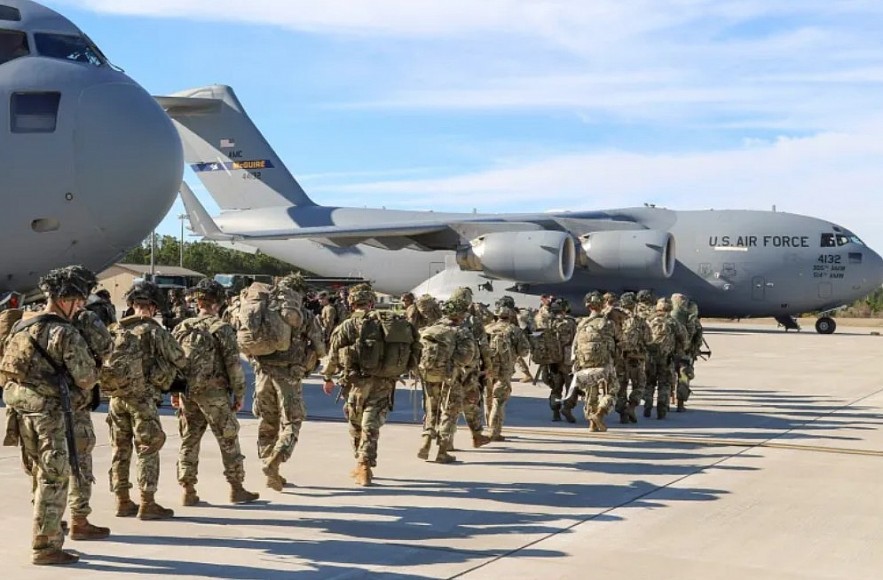 |
| America’s military buildup in the Middle East |
The United States has built one of its largest Middle East force packages in years, but the most important point is this: the deployment is large enough for sustained air and naval war, yet still looks too small for a full-scale invasion of Iran.
The current posture appears designed to give Washington multiple options at once, from deterrence and missile defense to strikes, maritime control and limited raids.
Read more: How Many U.S. Troops Have Died in the Iran War? 13 Killed, 300 Wounded (Latest)
How many U.S. troops are in the Middle East now?
The clearest recent baseline from Reuters is that the United States already had about 50,000 troops in the region before the latest reinforcements, with officials then preparing to send another 3,000 to 4,000 soldiers from the 82nd Airborne Division. Reuters also reported the dispatch of thousands more Marines and sailors tied to amphibious forces, which would push the total above that earlier 50,000 mark.
That number rose again at the end of March, when U.S. officials said more than 3,500 troops had arrived aboard the USS Tripoli amphibious ready group. AP reporting carried by CBS said that force included about 2,500 Marines from the 31st Marine Expeditionary Unit, while separate Reuters reporting had already described the earlier order sending the USS Boxer and its Marines toward the same theater. In practical terms, the U.S. regional footprint now appears to be in the low-to-mid 50,000s at minimum, and potentially trending higher as rotations and reinforcements overlap.
The geography matters as much as the number. U.S. forces are spread across bases and ports in Qatar, Bahrain, Kuwait, Iraq, Jordan and Saudi Arabia, a network that gives Washington air access, logistics depth and redundancy if one site is hit. That dispersed posture reduces vulnerability and makes it easier to sustain operations for weeks, which matches Secretary of State Marco Rubio’s public claim that U.S. objectives in the current war can be achieved without ground troops and within a relatively short timeframe.
How many U.S. warships are in or near the Middle East?
Exact ship counts change quickly, and that is one reason analysts should be careful with round numbers. AP reported earlier in the buildup that Washington had assembled the largest concentration of warships and aircraft in the region in decades, including two aircraft carrier strike groups and a naval presence that reached at least 16 ships at one point.
The complication is that the naval picture is now shifting. Reuters reported on March 28 that the USS Gerald R. Ford had reached Croatia for repairs after a fire, meaning one of the most important U.S. carriers has moved out of the fight for the moment. Reuters had also reported earlier that the USS George H.W. Bush would replace Ford, while the USS Abraham Lincoln had already entered CENTCOM waters back in January with guided-missile destroyers. So the best current description is not a fixed ship total, but a force centered on Lincoln, reinforced by amphibious ships such as Tripoli and Boxer, with Bush moving in as the Navy reshuffles its carrier coverage.
That naval mix is significant because it gives the U.S. two different kinds of power. Carrier groups provide long-range strike aircraft, missile defense and command capability, while amphibious assault ships bring Marines, helicopters, landing craft and in some cases short-takeoff fighter aircraft. In plain language, that means Washington is building a force not just for bombing, but for seizing, raiding or securing specific coastal or island objectives if it chooses.
How many U.S. military aircraft are in the region?
AP’s most detailed accounting said the U.S. buildup included more than 100 fighter jets, including F-35s, F-22s, F-15s and F-16s, alongside more than 100 refueling tankers and over 200 transport aircraft moving into supporting bases and the broader theater. That level of air support is not cosmetic. Tankers extend combat reach, transports feed the logistics chain, and fighters make sustained strike operations possible around the clock.
This matters because airpower is where the current U.S. posture looks strongest. A force package with 100-plus combat aircraft, carriers, tankers and forward bases is more than enough for a prolonged campaign against missile sites, air defenses, command nodes, naval targets and oil infrastructure. It is also the kind of posture that can isolate a battlefield before any raid or amphibious move.
So, could the U.S. actually put boots on the ground in Iran?
A full-scale invasion of Iran still looks unlikely. Reuters reported Rubio’s statement that U.S. goals can be met without ground troops, and that remains the strongest public clue to Washington’s preferred path. A ground invasion of Iran would require far more manpower, deeper logistics and broader political support than the current force suggests. It would also mean entering a country far larger, more mountainous and more complex than Iraq.
That does not mean ground action is off the table. Reuters separately reported that President Trump was considering whether to seize Kharg Island, Iran’s main oil export hub, and experts told Reuters that an operation there might require only 800 to 1,000 troops to seize the island itself, though holding it would be much harder. That is a very different scenario from invading mainland Iran. It is more limited, more surgical and far more compatible with the forces currently in theater.
This is the key distinction for readers: there is a big gap between ground operations and ground invasion. The current U.S. deployment looks insufficient for conquering Iran, but it does look credible for a narrower menu of ground actions. Those could include raiding coastal facilities, securing a chokepoint, seizing an island, rescuing personnel, or temporarily occupying a strategic node tied to maritime traffic or oil exports. Reuters’ reporting on Kharg Island fits exactly that kind of limited-war logic.
A deeper forecast: what is most likely next?
The most likely scenario is not a giant American landing on the Iranian mainland. The more persuasive forecast is a strategy built around airpower, naval pressure and tightly limited ground options. That approach would let Washington keep escalating pressure while avoiding the enormous costs of trying to occupy Iran. Rubio’s comments, the heavy emphasis on aircraft and ships, and the interest in targets such as Kharg Island all point in that direction.
A second, and still plausible, scenario is a short, high-risk amphibious or special-operations move against a specific objective in the Gulf. The arrival of Tripoli, the movement of Boxer, and the replacement of Ford with Bush suggest the Pentagon wants enough flexibility to pivot fast if diplomacy stalls or if Washington decides it needs a visible tactical gain. That would be dangerous for U.S. forces, because Reuters noted the threat from Iranian drones, missiles and naval mines even in a limited Kharg operation.
The least likely scenario remains a full-scale invasion of Iran. Nothing in the current force posture looks like the front-end of a 2003-style Iraq campaign. The troop numbers are too low, the public messaging is too cautious, and the practical military emphasis still sits overwhelmingly with air and naval power. The current buildup is best read as a force for coercion and selective intervention, not one for occupying a vast country. That is an inference based on the force mix and official statements, but it is the most grounded one available right now.
Bottom line
As of late March 2026, the United States appears to have more than 50,000 troops in the Middle East, a naval force that recently reached at least 16 warships during the peak buildup, and 100-plus fighter jets backed by a huge support fleet of tankers and transports. That is a serious warfighting posture. But it is better suited to air war, maritime control and limited raids than to a full invasion of Iran.
The sharpest way to put it is this: America looks ready to strike Iran harder, isolate key maritime and energy routes, and possibly seize a small but strategic objective if it thinks the payoff is worth the risk. It does not yet look positioned to march deep into Iran and stay there.