Who Controls the World’s Silver? Top Producers, Reserves and Supply Risks in a Tight Market

 |
| Where Silver Comes From |
Global Silver Production Snapshot (2024)
According to the World Silver Survey 2025 and USGS data, global silver mine production in 2024 was about 819.7 million ounces (≈25,500 metric tons). That marked a modest 0.9% increase year-on-year, driven by higher output from Mexico, Australia and recovery at key operations.
Read more: What Is Silver and Why Is It So Valuable? A Complete Guide as Prices Surge Toward $80
Top SilverProducing Countries (2024)
| Rank | Country | Estimated Production (Moz) | % of World Output |
|---|---|---|---|
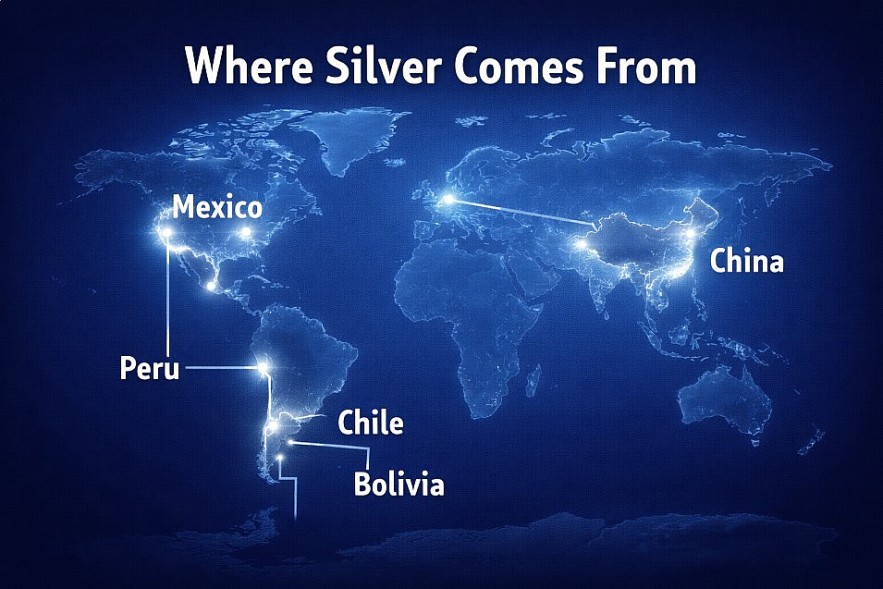
| 1 | Mexico | ~202 | ~24.3% |
| 2 | China | ~109 | ~13.2% |
| 3 | Peru | ~107 | ~12.9% |
| 4 | Chile | ~52 | ~6.3% |
| 5 | Bolivia | ~43 | ~5.1% |
| Source: World Silver Survey 2025 |
These five producers account for over 60% of global silver output — a concentration that tightens supply flexibility when demand jumps.
Read more: Top 16 Biggest Silver Mines of the World by Production
Known Silver Reserves: Where Future Supply Might Come From
Global reserves — silver that is economically feasible to extract with current technology — are significant but finite.
According to USGS estimates, total global silver reserves are in the range of ~530,000–570,000 metric tons.
Notable Silver Reserve Holders
-
Peru: Among the largest known reserves globally
-
Australia & Poland: Major reserves in developed mining regions
-
Russia & Chile: Significant yet under-tapped resources
Sources: USGS, InvestingNews/Nasdaq summaries
Reserves indicate potential to produce, not guaranteed annual supply. Turning reserves into output often takes years of permitting and infrastructure investment.
Read more: How Silver Is Used Today: From Electronics to Green Energy and Medical Technology
 |
| Silver Inside Your Life |
Why Supply Is Still Tight
Several structural factors limit how fast silver supply can respond to rising prices:
-
Most silver is a by-product of base-metal mining (lead, zinc, copper, gold), meaning new silver capacity depends on production of those metals.
-
Ore grades are declining globally, raising extraction costs.
-
Mining development cycles are long — large new projects can take a decade or more.
-
Recycling supplies remain limited, covering only a portion of global consumption.
These trends help explain persistent supply deficits. The World Silver Survey reports the market continued seeing deficits as total demand outpaced supply for multiple years.
Market Impact: Geography, Risk and Price
When a handful of countries produce the majority of supply, geopolitical and operational risks become market risks:
-
Labor strikes in large mining regions
-
Regulatory shifts in major producers
-
Export restrictions or trade policy changes
Each can tighten global availability and push prices higher — even in the absence of a demand surge.
What This Means for the Market
As prices trend upward, investors and industrial consumers alike are watching supply metrics closely. With demand from electronics, renewable energy and industrial sectors rising faster than supply growth, silver’s geographic concentration and reserve limitations could keep prices elevated.
In short: supply constraints aren’t just theoretical — they’re embedded in how and where silver is produced and stored.