April in Verse: 10 Poems About Love, Rain, and Quiet Renewal

 10 Most Famous English Poets of All Time 10 Most Famous English Poets of All Time |
 The 10 Most Beautiful Poems About May — A Month of Quiet Miracles The 10 Most Beautiful Poems About May — A Month of Quiet Miracles |
 Top 10 Greatest Poetic Quotes About June – A Celebration of Early Summer in Verse Top 10 Greatest Poetic Quotes About June – A Celebration of Early Summer in Verse |
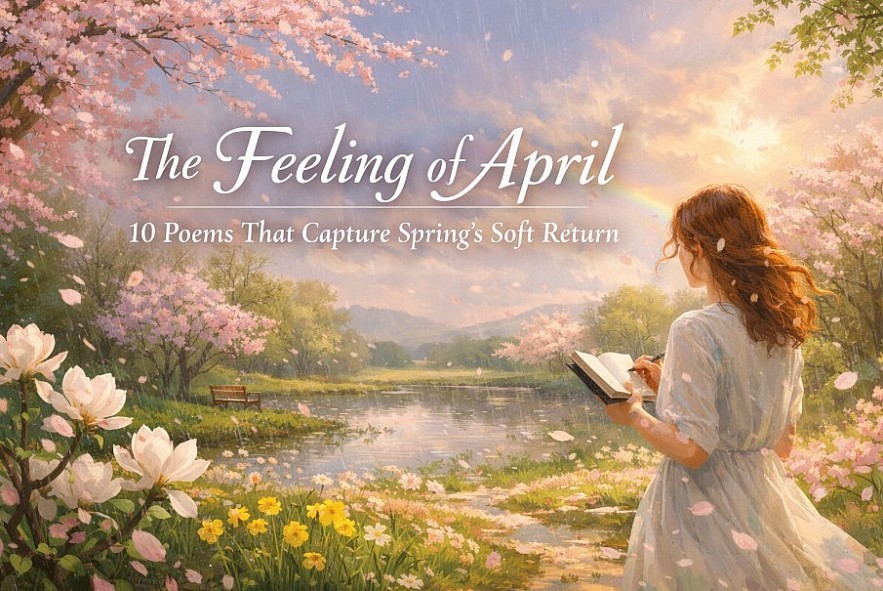 |
| The Feeling of April: 10 Poems That Capture Spring’s Soft Return |
April has always attracted poets for a reason. It is both tender and unsettled: the month of lilacs and mud, bright mornings and lingering grief. In the United States, it is also National Poetry Month, a celebration launched by the Academy of American Poets in April 1996, which helps explain why April keeps returning as poetry’s most symbolically crowded month.
For this list, I drew on recurring April-themed selections from the Academy of American Poets, Poetry Foundation features on spring and April, and editorial roundups devoted specifically to the month. Then I narrowed the field to ten poems that do more than mention April.
Each one gives the month a distinct emotional shape: desire, homesickness, renewal, irony, weather, memory, city light, or private awakening.
Read more: The 10 Most Beautiful Poems About April — And Why They Still Matter
1. “From you have I been absent in the spring (Sonnet 98)” by William Shakespeare
Published in the 1609 Sonnets, this poem remains one of the most memorable April lyrics in English because it does something subtle: it turns spring into a measure of emotional absence. Even “proud-pied April” cannot charm the speaker when the beloved is away. Shakespeare’s dates and the poem’s April opening are given on the Academy of American Poets page, and the poem also appears in classic April roundups.
A brief excerpt says almost everything: “When proud-pied April, dressed in all his trim...”
Why it belongs here: This is April as longing. The flowers are vivid, the season is in full costume, and yet the heart refuses to participate. It is romantic without being sweet, and that is exactly why it lasts.
2. “Home-Thoughts, from Abroad” by Robert Browning
Robert Browning, born in 1812, is one of the major Victorian poets, and this lyric is one of the most beloved April poems in English. Poetry Foundation’s page preserves its famous opening, where April becomes shorthand for England itself: hedges leafing out, birds calling, orchards leaning into bloom.
Its opening line is still irresistible: “Oh, to be in England / Now that April’s there.”
Why it belongs here: Browning gives April the glow of distance. This is not simply springtime; it is remembered springtime, imagined from elsewhere. The poem feels warm because it is homesick. It makes April seem like a place you can miss, not just a month you can name.
3. “The Waste Land” by T. S. Eliot
Few April openings are more famous than Eliot’s. First published in 1922, The Waste Land made “April is the cruellest month” one of the defining lines of modern poetry, and the Academy of American Poets notes the poem’s outsized influence on twentieth-century literature. Eliot’s biography page confirms his dates and literary importance, while the poem page records the 1922 publication.
The famous opening remains sharp: “April is the cruellest month, breeding / Lilacs out of the dead land...”
Why it belongs here: Eliot’s April is not soft-focus spring. It is the month that forces feeling back into a numb world. That reversal matters. In lesser hands, April is easy symbolism. In Eliot, it is disturbance. The season arrives not as comfort but as demand.
Read more: 6 Best AI Tools for Love Letters and Poems That Don’t Sound Artificial
4. “Spring” by Edna St. Vincent Millay
Edna St. Vincent Millay’s “Spring” is one of the great refusals in seasonal poetry. Poetry Foundation notes that the poem opens with the confrontational line “To what purpose, April, do you return again?” and also describes it as Millay’s first free-verse poem. The poem recurs in Poetry Foundation’s spring collection and in its April teaching feature, which places it among key April poems.
That first challenge still startles: “To what purpose, April, do you return again?”
Why it belongs here: Millay refuses the sentimental contract. April offers beauty, and the speaker answers with skepticism. That tension makes the poem unforgettable. It is for readers who have looked at crocuses and felt, at least once, that loveliness alone is not enough.
5. “April Rain Song” by Langston Hughes
Langston Hughes, born in 1901, wrote some of the most musical short poems in American literature. While the Academy page surfaced in search only indirectly, Poetry Foundation’s April feature explicitly includes “April Rain Song,” and Poetry Foundation has also highlighted the poem as one children memorized and recited, which speaks to its staying power and clarity.
One remembered phrase captures its mood: “Wistful, whispering April rain...”
Why it belongs here: Hughes hears April before he sees it. The rain is soft, repetitive, intimate. This is one of those rare poems that seems to arrive already half-memorized, as if it had always been in the language waiting for spring to bring it back.
6. “in Just-” by E. E. Cummings
Published in Tulips and Chimneys in 1923, Cummings’s poem is one of the most recognizable spring lyrics of the modern era. The Academy of American Poets page gives the poet’s dates and text, and an accompanying note explains the poem’s place in that first collection.
Its opening remains deliciously strange: “in Just- / spring when the world is mud- / luscious...”
Why it belongs here: April in Cummings is not polished. It is wet, playful, childlike, a little unruly. The poem remembers that spring is not only botanical. It is physical. Shoes get dirty. Children run. The world turns “puddle-wonderful,” and the language itself seems to skip rope.
7. “April” by James Schuyler
James Schuyler, born in 1923, was one of the New York School poets, and the Academy’s page for “April” preserves both the poem and the poet’s brief biography. The poem was published posthumously in Other Flowers in 2010, though Schuyler himself died in 1991.
A characteristic image from the poem is quietly luminous: “Cross-pollination / is the order of the fragrant day.”
Why it belongs here: Schuyler’s gift is attention. He does not announce April with thunder. He notices pear blossom, forsythia, clouding sky, and the almost painterly thinness of budding trees. The poem feels lived-in, as though spring were happening just outside the apartment window.
8. “April” by Alicia Ostriker
Alicia Ostriker, born in 1937, is a major contemporary American poet and critic; the Academy notes that she has been a finalist for the National Book Award and served as a Chancellor of the Academy of American Poets from 2015 to 2020. Poetry Foundation’s April feature specifically includes her poem “April,” placing it in direct conversation with Hughes and Millay.
The poem’s tone, as Poetry Foundation’s excerpt shows, begins by watching “optimists” take heart because it is spring.
Why it belongs here: Ostriker writes April with mature irony. This is not the innocent spring of schoolbook anthologies. It is a season seen by someone who knows history, politics, age, and disappointment, and still cannot help noticing the tulip. That doubleness makes the poem feel contemporary and true.
9. “Calmly We Walk through This April’s Day” by Delmore Schwartz
Delmore Schwartz’s poem appears both on Poetry Foundation’s spring collection page and on its own poem page, where the poem’s urban unease is unmistakable. Poetry Foundation’s poet page also notes that the poem carries Schwartz’s central themes: the life of the city, personal memory, and a sense of cosmic unease inside ordinary scenes.
Its opening line is beautifully disorienting: “Calmly we walk through this April’s day...”
Why it belongs here: Most April poems go to gardens. Schwartz goes to the city. Children scream, money structures distance, and history presses on the afternoon. The title promises calm, but the poem knows better. It gives us metropolitan April, where spring arrives through traffic, class, noise, and dread.
10. “April” by Sally Van Doren
Sally Van Doren’s “April,” first published in 2007, appears on Poets.org with both text and author biography. The Academy notes that Van Doren received the 2007 Walt Whitman Award, and her poem turns April inward, toward change, mood, and intimate address rather than landscape alone.
Its most memorable question may be this: “Why this need / to document change...?”
Why it belongs here: This is the most private poem on the list, and one of the loveliest. Magnolias and jonquils appear, but the real subject is emotional transition. Van Doren understands that April is not only something outside the window. It is also a rearrangement of thought, a shift in how one person dares to speak to another.
Why these ten stay with us
What makes April poetry so durable is not simply blossom or rain. It is contradiction. Shakespeare makes April beautiful but insufficient. Browning makes it distant and beloved. Eliot makes it cruel. Millay resists it. Hughes listens to it. Cummings plays in it. Schuyler watches it. Ostriker questions it. Schwartz urbanizes it. Van Doren interiorizes it. Together, they show why April remains poetry’s most emotionally crowded month.