Which Snake Is the “Biggest” in the World: 227 Kg, 8.43 Meters

 Top 10 Deadliest Snakes in the World That Are Likely to Kill You Top 10 Deadliest Snakes in the World That Are Likely to Kill You Interested in finding out about the most venomous snakes in the world? From rattlers to sea serpents to venomous vipers, these deadly snakes deliver a ... |
 Top 15 Best Snake Movies of All Time You Should Enjoy Top 15 Best Snake Movies of All Time You Should Enjoy Movies about snakes really attract viewers by their suspenseful details, suspense and eye-catching scenes. Today, KnowInsiders.com shares with you the top 15 best snake movies ... |
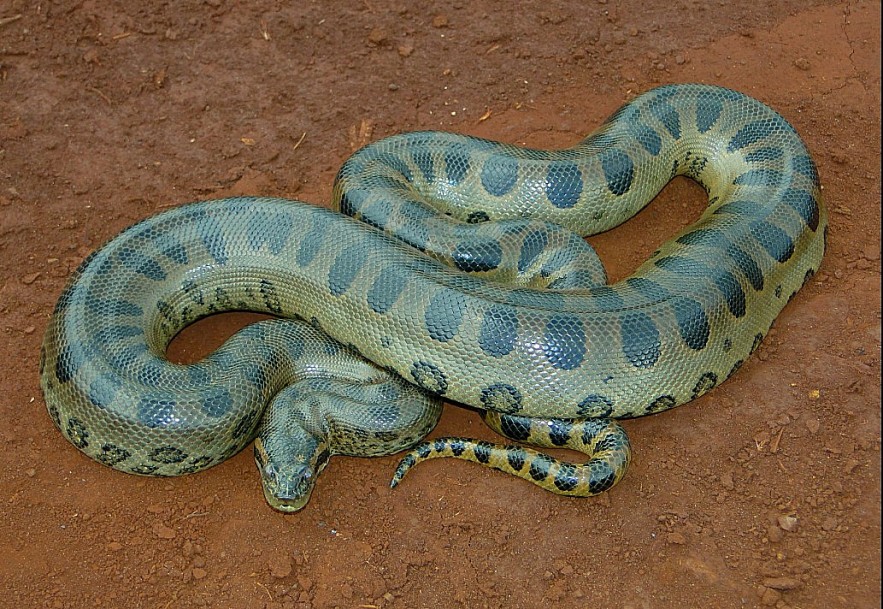 |
| Green Anaconda |
The Endless Fascination with Giant Snakes
Few animals capture our imagination like giant snakes. They appear in myths, films, and local legends, often portrayed as unstoppable forces hiding in deep forests and swamps. But beyond the stories lies a scientific debate that refuses to settle: what is the largest snake in the world?
To answer this question, we must look at hard measurements rather than myths. And once we do, one thing becomes clear. There is no single “biggest” snake. Instead, two modern species share the crown depending on how we define size: the Green Anaconda and the Reticulated Python. Then, lurking in the fossil record, lies an ancient monster that dwarfs them both.
The Green Anaconda: Champion of Weight and Power
When it comes to pure mass, the Green Anaconda stands unmatched. This South American titan, found in rivers and marshes of the Amazon and Orinoco basins, is the heaviest living snake on Earth. Large females, which are significantly bigger than males, can exceed 200 kilograms and stretch more than 6 meters in length. Some rare individuals have been reported at even greater sizes.
What makes the anaconda extraordinary is not only length but volume. Its body is thick, muscular, and built for grappling with formidable prey. Anacondas regularly take on caimans, capybaras, deer, and even large birds. Their strength comes from their dense bodies, which store immense power for constriction.
Unlike many snakes that rely on speed or agility, the anaconda prefers stealth and raw force. Hidden in dark water, it waits for the perfect moment to strike. Its bulk becomes an advantage, turning its entire body into a crushing mechanism capable of stopping almost any warm-blooded creature that enters its territory.
If the definition of “largest snake” focuses on mass, girth, or overall physical dominance, the Green Anaconda earns the top spot without contest.
The Reticulated Python: The Reigning Champion of Length
The Reticulated Python from Southeast Asia claims a different but equally impressive title. While it is not usually as heavy as the anaconda, it is the longest confirmed snake species in the world. Verified individuals exceed 7 meters, and many unverified local reports claim lengths approaching 9 or even 10 meters.
This species is long, slender, and highly flexible. Its patterned body gives it exceptional camouflage in tropical forests, allowing it to ambush prey from trees or dense undergrowth. The python’s strategy is precision rather than brute strength. Its long coils wrap quickly around prey, making it an efficient hunter of pigs, monkeys, and sometimes even larger animals.
Because of its extraordinary length, the Reticulated Python dominates discussions about the world’s longest snakes. If length is the deciding factor, this species wins every time.
A New Twist: Lessons from Prehistoric Giants
Although modern snakes are impressive, they cannot compete with the titans that once roamed ancient ecosystems. Fossil evidence reveals creatures far larger than anything alive today.
Titanoboa cerrejonensis
Roughly 60 million years ago, after the extinction of the dinosaurs, Titanoboa emerged as the apex predator of wet tropical forests. It is estimated to have reached nearly 13 meters and weighed more than one ton. Its size was made possible by the warm climate, which supported reptiles with higher metabolic needs.
Vasuki indicus
Another giant, discovered in recent years, may have grown even longer than Titanoboa. Although measurements vary, some interpretations place it close to 15 meters. While still under study, it represents one more example of how snakes once pushed bodily limits far beyond what modern species achieve.
These prehistoric giants show that the world’s largest snakes today are only shadows of ancient evolutionary potential.
Why the Definition of “Largest” Matters
The confusion around the term “largest snake” exists because size is multi-dimensional. A 7-meter python looks enormous stretched across the ground, but next to a fully grown anaconda, its relatively slender body may seem less imposing. Conversely, the anaconda may be shorter, yet its mass makes it more powerful.
To settle the debate, we must break the question into clear categories.
Heaviest Snake in the World
Green Anaconda.
Longest Snake in the World
Reticulated Python.
Largest Snake Ever Known (Extinct)
Titanoboa, with Vasuki as a possible rival.
Once these distinctions are made, the debate becomes easier to understand and far more interesting for readers curious about nature’s extremes.
Why Humans Are Obsessed with Giant Snakes
We fear them. We admire them. We exaggerate them. Giant snakes embody a blend of danger and mystery that fascinates cultures worldwide.
Part of their allure comes from how rarely we see them. Anacondas vanish into dark water. Pythons disappear into forest shadows. Even today, reports of giant snakes spark debate because these animals live in places humans struggle to explore.
Another reason is their role in ecosystems. Large snakes sit at the top of the food chain and help maintain balance in their environments. Their presence signals a healthy and functioning ecosystem, yet their populations often face threats from habitat loss and human conflict.
Conclusion: So Which Snake Wins the Crown?
The answer depends on how you measure greatness.
If you value weight, choose the Green Anaconda.
If you value length, choose the Reticulated Python.
If you look back through time, Titanoboa towers above them all.
Each of these giants is remarkable in its own way, and together they tell a story of evolution, adaptation, and the incredible diversity of life on Earth. The world’s largest snake is not just an animal. It is a reminder of nature’s ability to push boundaries and surprise us.